The internet can’t decide whether to cheer or clutch its pearls
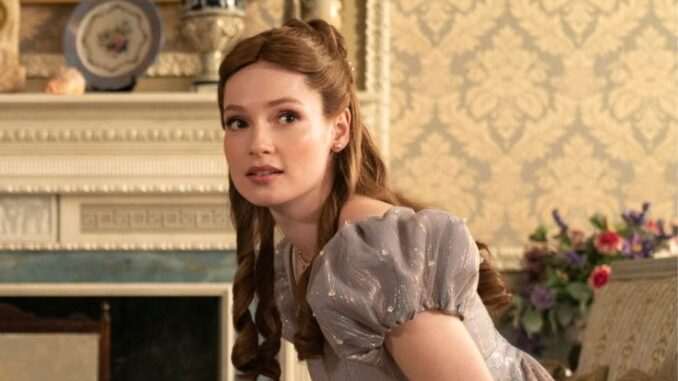
Dearest gentle reader, the ton is once again abuzz. Season five of Bridgerton promises a new chapter of yearning, this time in the form of a lesbian romance. Widowed Francesca Bridgerton is set to fall for Michaela Stirling and, plot twist… they are both mourning the same man, Francesca’s late husband and cousin, Lord John Stirling.
The announcement has split the fandom like rival houses at a Bridgerton ball. There’s celebration that a major franchise is finally centring a sapphic romance, although others are less enthused, insisting that Eloise should have been next in line. Then there’s the group whose grievances seem rooted in the discomfort of seeing a feminine woman explore same-sex desire at all.
The frustration over Eloise is not entirely unfounded, especially for book series purists. The fifth book writes of her throwing caution to the ton and dashing off to the countryside to meet Sir Phillip Crane. Yet on-screen, Eloise shows she isn’t ready for romance. She reflects in season four at Benophie’s wedding, “I do love a wedding..as an attendee.” Eloise has long rejected traditional patriarchal expectations, challenging ideas of marriage and motherhood by her independence and choice to grow intellectually.
Fans have often “shipped” Eloise with her closest female companions, Penelope Featherington and Cressida Cowper. Even actress Claudia Jessie has acknowledged that fans could envision a queer romance for her, noting there is “definitely room” for such a storyline. Showrunner Jess Brownell, who is openly queer, explained that the creative team wanted to leave space for a character whose primary focus is not romance. For now, Eloise is “genuinely more interested in cerebral pursuits” and finding her place in a society that doesn’t make much room for women like her.
Eloise’s defiance and feminist energy are exactly what led many fans to read her as queer and, in turn, what fuels the scepticism toward Francesca. She is her opposite, embodying the gentle, reserved, and traditional feminine, now with a Black woman as her love interest. The backlash reveals just how narrow the accepted image of queerness remains.
Brownell has stated that there is “no place for homophobia or racism” within the world of Bridgerton, yet audience responses suggest those biases are not so easily written out. Some criticisms are framed through fidelity to the source material with a preference for Michaela’s original male counterpart. The intensity of the backlash also reveals something deeper about who is allowed to be seen as desirable.
Black queer women are rarely positioned at the centre of romantic fantasy. When they appear on screen, it is often within narratives of struggle or marginalisation, not as the object of soft, sweeping longing. Francesca and Michaela disrupt that pattern. Their story asks audiences to see a Black woman not just as desirable, but as the romantic ideal within a world defined by beauty, luxury, and excess. For some viewers, this proves unexpectedly difficult to accept.
The complaints, however, do not stop there. Some fear Francesca’s infertility storyline will be lost. In the books, her struggles with miscarriage and her longing for motherhood are central to her character. Yet a queer relationship does not erase that possibility and if anything, it offers an opportunity to explore the same grief and desire from a new and equally complex perspective. There’s also an insistence that it’s “not period accurate.” Are we forgetting that the Bridgertons already live in a Regency where women of colour attend balls in couture gowns and acrylic nails exist somewhere between Meryton and Mayfair? These critiques reveal the underlying assumptions that queer stories cannot explore themes like grief and motherhood with equal depth.
This is where the conversation moves beyond Bridgerton itself, because the response to Francesca isn’t happening in a vacuum. Unless you’ve been living under a rock, Heated Rivalry has had the internet in a chokehold, becoming one of the most talked-about queer shows of the year. Its audience extends far beyond queer viewers, with straight women in particular embracing it with near-obsessive enthusiasm.
Part of that appeal lies in how queer male stories are framed and understood. They centre mutual desire without the baggage of traditional gender roles, allowing both characters to exist on equal footing, being equally vulnerable, equally desirous. For many viewers, this creates a kind of freedom and intimacy that feels raw and emotionally expansive, without replicating the power imbalances that often shape heterosexual romance. There is also a degree of distance at play and an ability to engage with queerness that feels removed enough to be comfortable, even escapist.
Queer women, by contrast, are picked apart, especially within a show that has historically centred heterosexual romance. The same audiences who revel in the raw, unafraid physicality and emotional intimacy of queer male narratives seem unsettled when a woman’s desire is given that same depth and intensity. Female desire, especially when it is active, initiating, and unapologetic, has long been subject to scrutiny. It is expected to be softer. So when a story like Francesca’s places a woman at the centre of that same raw, unfiltered longing, it can feel confronting. The discomfort, then, is not simply about queerness, but about women being allowed to want openly, and without restraint.