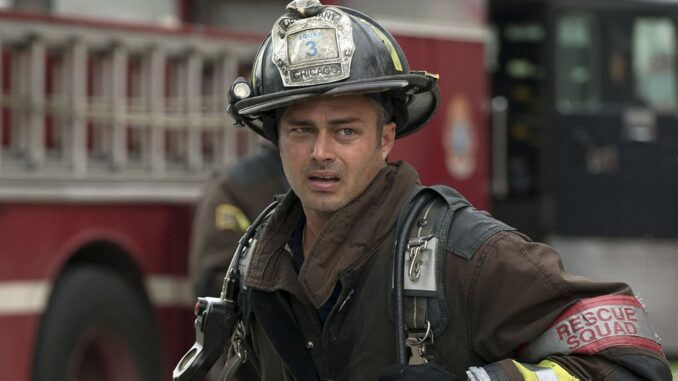
Long before Taylor Kinney became synonymous with Kelly Severide on Chicago Fire, his career took a surprisingly prestigious turn almost immediately after joining the NBC drama. Kinney’s breakout as the confident, complex firefighter didn’t just make him a fan favorite—it opened doors in Hollywood faster than many viewers realized.
Shortly after Chicago Fire premiered and began gaining traction, Kinney landed a role in Zero Dark Thirty (2012), Kathryn Bigelow’s critically acclaimed film about the hunt for Osama bin Laden. The movie went on to win the Academy Award for Best Sound Editing and earned multiple Oscar nominations, firmly establishing itself as one of the most important films of the decade.
While Kinney’s role wasn’t a leading one, the significance lies in the timing. Transitioning from network television to a prestige, Oscar-winning film so early in his run on Chicago Fire signaled industry confidence in his talent. It showed he wasn’t just being cast for looks or action-hero presence—he was trusted to be part of a serious, high-stakes cinematic project led by an Oscar-winning director.
That momentum helped shape how Severide himself was written and perceived. Kinney brought a grounded intensity and emotional restraint that elevated the character beyond typical procedural archetypes. Over time, Severide evolved into one of Chicago Fire’s most layered figures—something that mirrors Kinney’s own career path, balancing mainstream success with critically respected work.
Looking back, it’s clear Chicago Fire wasn’t just a lucky break—it was a launchpad. Kinney’s near-immediate leap into an Oscar-winning film underscores how quickly he moved from promising TV newcomer to actor with serious industry credibility. And more than a decade later, as he remains a cornerstone of Firehouse 51, that early milestone still stands as proof that his rise was no accident.