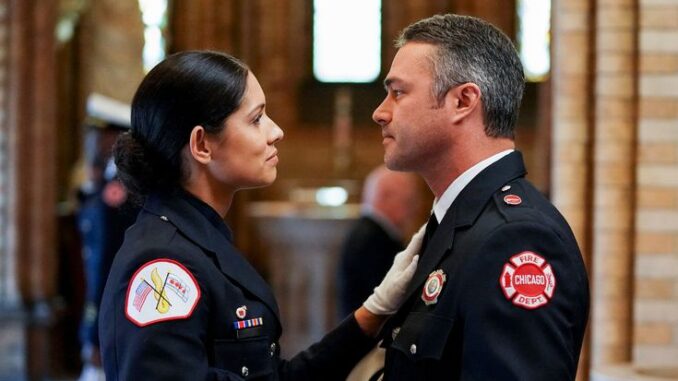
For more than a decade, Chicago Fire, Chicago Med, and Chicago P.D. have formed the backbone of NBC’s primetime schedule. Together, they are more than just a trio of procedural dramas — they are a shared television universe that has cultivated one of the most loyal audiences in broadcast TV. So when renewal season rolls around, fans understandably hold their breath.
The good news? Industry expectations strongly suggest that all three series will return for another season.
The more complicated news? Those renewals are likely to come with noticeable budget reductions — and that could mean real changes both on-screen and behind the scenes.
Let’s break down what’s happening, why cost-cutting is becoming inevitable, and what it could mean for the future of the One Chicago universe.
A Franchise That Became a Broadcast Powerhouse
When Dick Wolf launched Chicago Fire in 2012, few could have predicted that it would grow into a three-show juggernaut. The series introduced audiences to the firefighters and paramedics of Firehouse 51 — but more importantly, it laid the groundwork for something bigger.
Chicago P.D. followed in 2014, focusing on the city’s Intelligence Unit. Chicago Med arrived in 2015, bringing viewers inside Gaffney Chicago Medical Center. Together, they formed what fans now simply call “One Chicago.”
Crossovers became annual events. Characters moved fluidly between series. Emotional arcs carried across different shows in the same week. It wasn’t just shared branding — it was a cohesive, interconnected world.
For NBC, that kind of ecosystem has been gold. Wednesday nights became synonymous with Chicago. The shows have consistently delivered solid ratings relative to modern broadcast standards, especially in delayed and streaming viewing.
But television economics have shifted dramatically since 2012.
Why Renewals Are Still the Smart Move
Despite financial pressures, there are several reasons renewals are widely expected.
1. Stability in a Volatile Landscape
Broadcast television has seen a wave of cancellations in recent years. As streaming platforms dominate attention and advertising models evolve, networks are increasingly cautious about launching new scripted dramas — especially expensive ones.
Replacing a long-running hit is risky. Keeping a known performer with a built-in audience is safer.
The Chicago shows provide:
-
Established fanbases
-
Strong international sales
-
Reliable streaming performance
-
Built-in promotional synergy
That level of predictability is rare in 2026.
2. Franchise Branding Matters
NBC’s identity is tightly intertwined with Dick Wolf’s procedural empire. Alongside the Chicago shows, Wolf also oversees the Law & Order universe.
Procedurals remain one of the few formats that consistently perform in traditional broadcast. They are accessible, episodic, and easy for new viewers to jump into. That makes them valuable for both advertisers and streaming libraries.
Letting go of the Chicago trio would create a noticeable void in NBC’s weekly lineup.
3. Syndication and Library Value
Long-running shows build massive episode libraries. These libraries generate ongoing revenue through:
-
Syndication
-
International licensing
-
Streaming deals
-
Cable reruns
Each additional season strengthens that long-term value proposition.
From a purely business perspective, renewals make sense — even if belts need tightening.
Why Budget Cuts Now Feel Inevitable
The entertainment industry in 2026 is navigating a different financial reality than it was five years ago.
1. Advertising Revenue Pressures
Linear television advertising has softened. While live sports remain strong, scripted dramas no longer command the same premium ad rates they once did. Networks must operate leaner while competing with global streaming giants.
2. Rising Production Costs
After more than a decade on air, cast salaries inevitably rise. Veteran actors renegotiate contracts. Crew costs increase. Production expenses — from insurance to location permits — have climbed across the board.
A series entering its 13th or 14th season is significantly more expensive than one in its third.
3. Industry-Wide Cost Containment
Major media companies have been focused on restructuring, consolidation, and profitability after years of aggressive streaming expansion. The emphasis has shifted from growth-at-all-costs to sustainability.
Even successful shows are not immune to financial recalibration.
What Budget Cuts Could Actually Look Like
Budget reductions don’t necessarily mean a creative collapse. But they often manifest in subtle, cumulative ways.
1. Shorter Episode Orders
Instead of 22 episodes per season, networks may opt for 18–20. Fewer episodes reduce production costs while maintaining presence on the schedule.
2. Cast Adjustments
Long-running procedurals frequently rotate series regulars to recurring status. Some characters may appear in fewer episodes to control salary costs.
This doesn’t automatically mean beloved stars are leaving — but screen time could shift.
3. Fewer Large-Scale Action Sequences
Chicago Fire, in particular, is known for elaborate rescue scenes. Explosions, multi-vehicle accidents, and high-intensity set pieces are expensive.
Budget-conscious seasons may lean more heavily into character-driven storytelling and contained emergencies.
4. Reduced Crossovers
Crossovers are fan favorites — but they are logistically complex and costly. Coordinating casts and production schedules across three shows is not cheap.
If cuts are implemented, crossover frequency could decrease.
Creative Risks — and Opportunities
Cost-cutting isn’t always negative. In some cases, constraints force sharper storytelling.
When large-scale spectacle becomes limited, writers often lean deeper into character psychology, relationships, and moral dilemmas.
Some of the Chicago franchise’s most memorable episodes have been emotionally intimate rather than action-heavy.
However, there’s a delicate balance.
Cut too deeply, and viewers notice.
Procedurals rely on a sense of authenticity — realistic emergency responses, compelling crime investigations, and hospital urgency. If budget reductions begin to visibly affect production value, audience trust can erode.
Fan Reaction: Loyal but Watchful
The One Chicago fandom is passionate — and protective.
After more than a decade, viewers have invested deeply in these characters. Changes to cast dynamics or production scale won’t go unnoticed.
But fans have also weathered cast departures before. The franchise has proven surprisingly resilient through transitions.
The bigger question is whether budget cuts will feel like natural evolution — or obvious downsizing.
NBC’s Broader Strategy
NBC’s current strategy appears focused on:
-
Fewer, stronger scripted brands
-
Event programming
-
Reality competition
-
Live sports
Within that ecosystem, the Chicago trio remains one of its most dependable scripted pillars.
Renewing them — even with reduced budgets — aligns with a strategy of maintaining proven IP while carefully managing costs.
The Long-Term Outlook
All three Chicago shows are now deep into long-running territory. Historically, few broadcast dramas last beyond 15 seasons without significant evolution.
So what happens next?
There are a few possible trajectories:
-
Gradual scaling down over multiple seasons
-
Phased endings announced in advance
-
Continued renewals with leaner production models
-
Event-style shorter seasons
The most likely short-term outcome? Renewal announcements accompanied by subtle cost restructuring.
In the long term, NBC and Dick Wolf will have to decide whether sustaining three interconnected series remains financially viable — or whether consolidation becomes inevitable.
Final Thoughts
Renewals for Chicago Fire, Chicago Med, and Chicago P.D. appear highly probable. The franchise remains too valuable, too stable, and too central to NBC’s identity to abandon outright.
But television economics have changed.
Budget cuts are no longer a red flag — they’re part of the modern broadcast equation.
The real question isn’t whether the Chicago shows will return.
It’s whether they can adapt to leaner production realities without losing the emotional intensity and procedural authenticity that made them cornerstones of network television in the first place.
For now, fans can likely breathe a cautious sigh of relief.
The sirens aren’t going silent just yet.