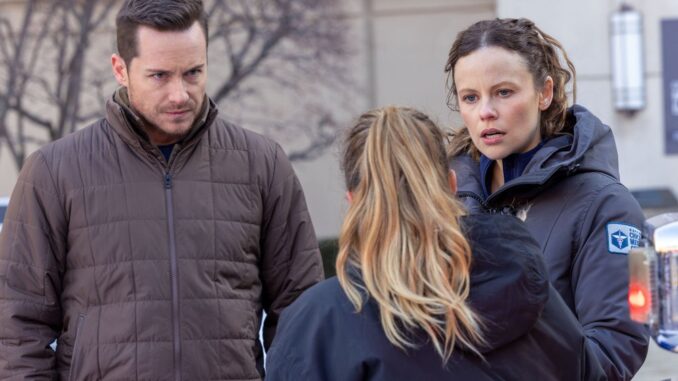
The One Chicago crossovers are often as challenging as they are compelling.
If, like me, you aren’t as familiar with all three One Chicago shows, some aspects can be confusing or hard to invest in.
I’m piggybacking off of Alexandria Ingham‘s review of Chicago Fire Season 14 Episode 11 to discuss the second part of the three-hour event, which focused on Gaffney’s role in the biohazard crisis.
Lenox’s Role In The Crossover Allowed For Another Side to Her Character
Throughout Chicago Med Season 11, Lenox has been struggling with reckless behavior because of her diagnosis, so it was a nice change of pace for her to be in a supporting role rather than the one running headfirst toward danger.
Of course, during the first part of the crossover, she got cuaght up in that ridiculous blowtorch situation, but she wasn’t the one who insisted on jumping into the ambulance even though it was potentially dangerous — Hannah was.
Hannah’s earlier insistence that she had to get into that ambulance made it virtually certain she would do so sooner or later, so this plot point wasn’t surprising.
However, it led to some of the strongest drama between Hannah and Archer yet in this whole baby arc.
Archer’s true feelings about Hannah and their baby surfaced in the most obnoxious, Archer-like way possible.
He’s a character I often love to hate more than I love, though he’s softened in recent seasons, and I will forever be thrilled that he’s stopped doing manipulative things like putting patients in comas to override their wishes.
In this case, I couldn’t blame him for being angry that Hannah boarded that ambulance, even if the way he expressed it came off as more controlling than caring.
Neither the decision to go into the ambulance nor how to handle the contamination risk afterward was his to make, even if Hannah is carrying his child, and it was unsurprising that she reacted bitterly to his acting like she had no right to make those choices.
At the same time, he was correct that she wasn’t thinking of their baby at all.
Hannah never considered for a moment that a pregnant OBGYN wasn’t the best choice to treat a pregnant woman who had been exposed to an unidentified and fatal chemical.
She was only thinking of trying to save the baby and mother, and if her own pregnancy entered into it at all, it was only in terms of what she would want someone to do if she were the woman in the ambulance.
It’s understandable that her decisions came off as selfish to Archer because, at that moment, she was thinking like a mother-to-be with medical expertise, not a mother who was putting her unborn baby’s safety first.
That annoyed me, too, because I do not want Hannah to miscarry, and I’ve been worrying all season that each week’s episode is the one where it will happen. So the episode-ending cliffhanger, with Hannah refusing the benzos and other preventive treatment, was doubly tense for me.

It seemed like this incident was building toward a sad turn of events, and that put me more on Archer’s side than I usually would be, even though I didn’t like the way he was behaving toward Hannah.
The fact that both sides of this conflict had valid points demonstrated how good Med’s writing can be when it wants to be, and it was an added bonus that Archer’s strongest scenes on Chicago Med Season 11 so far aired on Steven Weber’s (the actor who plays Archer) birthday.
Dr. Charles’ Role Was Strong, But Not When It Came To Hannah and Archer
It’s no secret that Dr. Charles is my favorite character. I used to work in a similar field and love it when mental health treatment is taken seriously on TV.
His strongest scenes were with Macy and her mother.
Although I don’t watch Chicago Fire regularly enough to understand all the nuances of these relationships, Charles’s attempts to support Pamela drew me in.
However, I was disappointed that he didn’t get to play the same role for Hannah and Archer.
Other than one half-hearted suggestion that everyone cool down, he didn’t involve himself in this story at all, and that was a shame.
If anyone knew how to intervene with these two and get them to understand what they were really fighting about, it was him.
With the ongoing crisis and the need to stop people from visiting their friends and family in the fire department, though, Charles had more than enough to do.
Everyone was stressed out, making this crisis seem more realistic than most such stories, and pushing the main plot forward quickly.
Although there was quite a bit of Fire and some PD in the subplots, the second part of the crossover felt more like a standard Chicago Med episode than the previous crossover, which was far too much like a 3-hour episode of Chicago Fire for my liking.
I liked the 2026 One Chicago crossover better than 2025 — how about you?