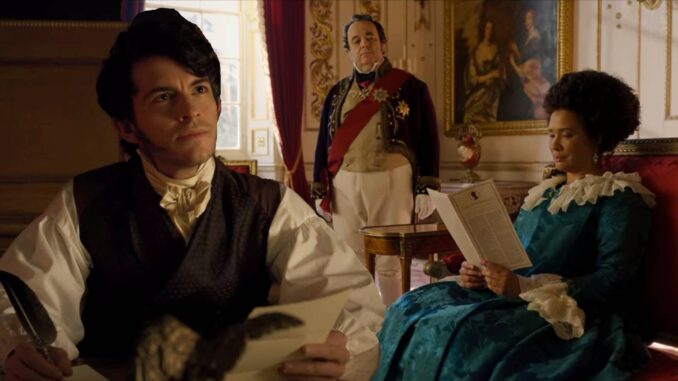
Since Bridgerton premiered, viewers have been delighting in Regency-era English. Who at this point doesn’t know what the “ton” is? But did you know that the word to describe England’s social elite — the people in the series who hang on Lady Whistledown’s every word — comes from the French term le bon ton, which means “good manners”? A “modiste,” we now understand, is a dressmaker and seamstress of fashionable clothing. And while “rake,” to most of us, was a gardening tool, we know that in 1800s London the word derived from rakehell meant a charming, flirtatious upper-class man who engaged in womanizing, promiscuous behavior. Yes, our beloved brothers Anthony and Benedict were both accused of rakish behavior pre-Kate and Sophie, and needless to say, they fit the bill.
But season four of Bridgerton brought us even more Regency vocab to sink our teeth into, so make haste, dearest gentle reader! It’s time to dig into the terms that give Bridgerton part of its charm.
Ward
We learned in the first season, when Marina moved in with the Featherington family, what a ward is, but everyone can benefit from a lesson in repetition, especially as the word pertains to Sophie Baek.
A ward is a legal dependent under a guardian’s care. In episode two, when Sophie’s father introduces his illegitimate child to her new stepmother, Araminta, he refers to Sophie as his ward. The thought process there is that it would be better for Sophie’s social status that she be considered an orphan taken in by a generous benefactor than the child of a nobleman and a member of the service staff. The look on Araminta’s face in the flashback indicates that she understands exactly what Sophie’s relationship is to her new husband, but as long as Sophie’s father was alive, the cover story appeared to work for all of them.
Pinnacle
Remember in the inaugural season how Daphne revealed her confusion about the completion that comes at the end of the marital act, the one that would be required for Simon to sire an heir (conceive a child)? Well, we now turn our gaze to the women of Bridgerton, Francesca in particular, as they go about reaching their “pinnacle.”
The euphemism for an orgasm — described by Penelope as “a sensation that occurs between your legs and spreads through your entire body that may have you shouting into the night,” and Lady Bridgerton as “a magical, special feeling inside” that is “more than pleasant” — was not uncommon in the Regency era. What would have led even more ladies to discuss it was that many believed that reaching this pinnacle was a necessary part of conception. Which leads us to …
Courses
After the pinnacle starts the counting. While there is no shortage of passion in the lives of the Bridgerton family, the first form of contraception beyond coitus interruptus didn’t arrive until the invention of rubber (I mean, there is evidence of people using linen, sheep, or fish intestines to protect against unwanted pregnancies). In the new season, both Sophie and Francesca have their courses neatly marked, counting days for different reasons. Once four weeks have passed, their presence or absence would be either cause for concern or elation. Of course, counting the days between one’s menstruation can be as effective as the duke’s contraception method — an inexact science at best.

Countenance
Lady Bridgerton has always been concerned about proper decorum, constantly chiding Eloise for her poor deportment and countenance. “If you cared as much about your deportment as your books,” she scolded a scowling Eloise in the first season. But we adore watching Eloise contort her face, whether it’s with a merry or disapproving countenance. The word can also refer to losing one’s composure or being embarrassed, as in “out of countenance.” But in Eloise’s case, the idea of proper deportment in order to secure a suitor means little because she intends to avoid the marriage mart altogether and place herself …
On the shelf
The social season, which in the Regency era coincided with the meeting of Parliament and involved a series of balls and soirees, used to be a given for a debuting Bridgerton daughter, whose introduction to society aided them in finding eligible men to marry. Eloise — who in her own season avoided being given the title “Diamond of the First Water,” or the cream of the crop as declared by Queen Charlotte — has a different idea of what awaits her in life, enthusiastically declaring her intention to become a spinster instead.
“I shall put myself on the shelf,” she declares, making what in the early 19th century meant having no real prospects for marriage more of an active decision. The phrase “on the shelf” is a synonym for spinster, which surprisingly was less of a derogatory expression back then, being simply a legal description, than it is now.
Courtesan
There is another fate for an unmarried woman, and it is something Sophie does not want to entertain, thank you very much. When Benedict asks her to be his mistress, she turns him down, saying she refuses to live as a “glorified courtesan.” In the Regency era, a courtesan was a sex worker with a high-end clientele, usually involving a financially supported, long-term relationship. But Sophie knows it would also end in her being deemed a ruined woman, which for someone already thinking she is an illegitimate child is a bridge too far.
Ruined
Certainly, being someone’s mistress could make a woman in this time period a ruined woman, but the characters in Bridgerton — the women especially — are almost all engaging in the kind of premarital activities that could compromise their virtue and thus risk being considered social pariahs who could ruin the reputation of anyone they come in contact with. Lucky for us, the characters we so adore have gotten away with their premarital or extramarital sexcapades, leaving them free to socialize with the rest of the ton.
Tea
There are a number of respectable ways one could call upon a lady in the early 1800s. A promenade, meaning a stroll in public, would be one way for a man and a woman to become better acquainted. The dance card allows suitors to write their name on a card tied around a woman’s wrist, hoping that a waltz might seal the deal. And then, there is the calling hour, where a suitor can visit a lady and get to know her over tea. But to anyone who watched this season, tea has taken a whole new sizzling meaning. So, let us leave you with the legendary quote from Lady Bridgerton to Marcus Anderson that would make the ton swoon: “I am the tea that you are having.”