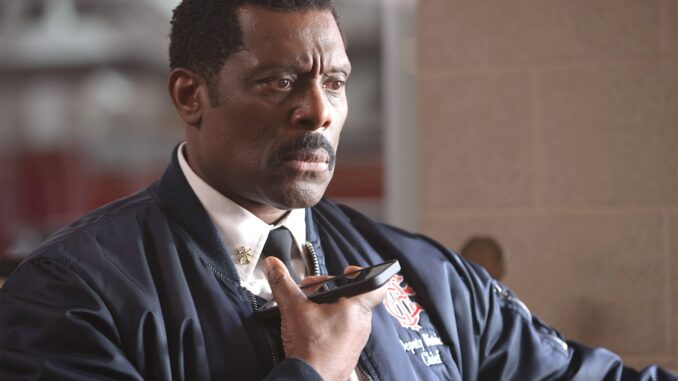
For over a decade, Eamonn Walker did more than play Chief Wallace Boden on Chicago Fire—he embodied him. In a television landscape crowded with procedural leads, Walker carved out a presence that felt steady, commanding, and deeply human. His legacy is not simply tied to a character. It is rooted in the way he redefined leadership on screen.
From his first appearance at Firehouse 51, Boden was not portrayed as the loudest man in the room. He was the calmest. Walker infused the role with restraint, gravity, and emotional intelligence. He understood that true authority does not need to shout. It listens. It observes. It steps forward only when necessary—and when it does, people follow.
What made Walker’s performance remarkable was the balance between strength and vulnerability. Boden was a chief responsible for lives, yet he was also a husband, a father, and a mentor. Walker never allowed the uniform to overshadow the humanity. In moments of loss, his quiet reactions often carried more weight than dramatic speeches ever could.
Beyond the firehouse walls, Walker’s impact extended to representation. As a Black British actor leading a major American network series, he brought nuance and dignity to a role that could have easily fallen into cliché. Instead, Boden became a layered figure of authority—respected not because of intimidation, but because of integrity.
His mentorship arc also left a lasting imprint. Whether guiding Severide, supporting Stella Kidd, or standing firm beside his firefighters during crises, Boden represented a model of leadership built on accountability and compassion. In a show filled with physical heroics, Walker highlighted moral courage—the willingness to stand for what is right even when it is difficult.
Colleagues have often spoken about Walker’s presence on set mirroring his character’s steadiness. There is a consistency to his craft that reflects discipline and deep respect for storytelling. He doesn’t chase attention; he commands it naturally.
As Chicago Fire evolves, Walker’s contribution remains foundational. Firehouse 51 was shaped not only by action sequences and dramatic rescues, but by the leadership at its helm. Boden’s office became a space for truth, conflict resolution, and hard-earned wisdom. That atmosphere was built through Walker’s performance.
Calling Eamonn Walker “more than just an actor” isn’t exaggeration—it’s recognition. Through Chief Boden, he created a character who stands as a monument to courage: not just the courage to run into burning buildings, but the courage to lead, to protect, and to care deeply.
Television often celebrates spectacle. Walker gave us substance. And that legacy will endure long after the sirens fade.