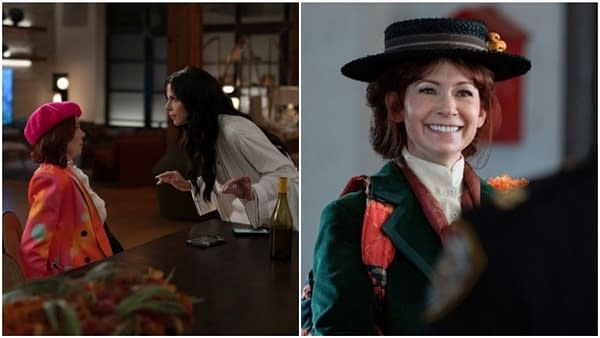
Elsbeth Season 3 Episode 12 started with one of its zaniest crimes yet.
The narration by the criminal of the week was a nice touch as he fought to get his wig supplies, stole a client from a well-known wig designer, and ultimately killed his rival.
It felt more than ever like Elsbeth is the spiritual sister of Hulu’s Only Murders In The Building, making for an enjoyably ridiculous story, despite an annoying subplot involving Captain Wagner and a spoiled middle schooler.
Elsbeth Season 3 Episode 12 Focused on a Nerdy Wig Designer
There have been several times when over-the-top cases have gone too far on Elsbeth Season 3.
Fortunately, this wasn’t one of them.
Elsbeth’s brand is silly cases, so I can’t complain about a cast of ridiculous characters with even more outlandish motives, as long as it is entertaining and the story makes internal sense.
Elsbeth Season 3 Episode 12 hit the sweet spot. The idea of a small number of wig designers for the stars who took their jobs incredibly seriously was goofy, but the story kept my attention for most of the hour.
Elsbeth Made A Strong Deduction Right Off The Bat
The point of this series isn’t just supposed to be the ridiculousness of it all — part of its brand should be Elsbeth noticing things that the regular police miss.
Too often lately, that aspect has taken a back burner to the weirdness, but not this time.
I loved that Elsbeth immediately picked up on the curling iron being missing and how that fact figured into the crime.
For once, she and Smullen were able to work together to put together the theory that someone strangled the victim with the curling iron and then left with it. But Elsbeth’s realization that the culprit would have burned themselves as well was the kind of brilliant deduction that’s been missing throughout the season.
That deduction also led to a hilarious moment when Smullen was trying to interview one of the other suspects, and Elsbeth kept staring at her, searching for hidden burn marks on her hands or arms.
That said, it wasn’t particularly clear why Elsbeth zeroed in on Felix as the killer.
She kept returning to his wig shop, supposedly to try on new wigs, so it was obvious that she suspected he was involved in the murder, but the reason never came up.
She never discovered or asked about the burn mark on his head, which would have sealed the deal.
She also didn’t argue with Wagner or any of the detectives about why she thought Felix was guilty. I appreciated that — I hate that silly trope — but it also prevented her from explaining her thinking.
As silly as the idea is of the cops doubting her when she’s been right so many times, at least arguing with them forces her to defend her theory.
Smullen’s Wig Issue Offered A Strong Theme
Instead, Elsbeth, Season 3, Episode 12, offered a mini-plot about everyone insisting that Smullen needed to wear a wig.
Some of the most hilarious moments of the hour came from Smullen’s wig issue. I especially liked Smullen wondering if everyone in the squad room but him was wearing a wig.
The look on Wagner’s face during all the discussions of wigs also cracked me up. It was clear he thought this conversation was as beneath him as all that nonsense with the middle school girl.
That Bullying Subplot Didn’t Work At All
Wagner’s subplot was the weakest part of Elsbeth Season 3 Episode 12.
Bullying is a serious issue, but Elsbeth didn’t take it seriously, especially when the entitled “victim” admitted she made the whole thing up to get out of a riding competition that she didn’t want to participate in.
I guess the joke was supposed to be how ridiculous this father and daughter were, but it inadvertently sent a different message about bullying being a joke, or at the very least, something that kids shouldn’t bother adults about.
Elsbeth is far more lighthearted than The Good Wife, so I don’t expect it to make scathing social commentary.
Still, if it’s going to address a serious problem, it shouldn’t do it in a frivolous manner like that.
The Winnie subplot was handled much better than the Wagner one.
This story is supposed to be suspenseful, so it’s not played for laughs.
As a result, Winnie’s revelation in the last scene made for an effective cliffhanger.
I’m not thrilled with this Alec storyline, but Winnie playing both sides made it a lot more interesting.
Similarly, I wondered why Teddy was calling Elsbeth now.
Despite her excitement that he broke the silence, I had a feeling it wasn’t a friendly call.