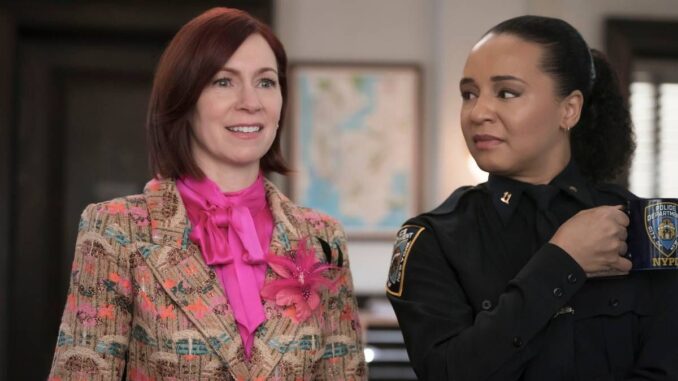
In a television landscape where genre lines are increasingly fluid, one of the most intriguing shifts in recent awards-season conversation centers around Elsbeth. Once comfortably framed within the dramatic tradition of legal and procedural storytelling, the series has now found itself at the heart of a surprising Emmy conversation — not for drama, but for comedy.
Yes, comedy.
The shift has sparked debate among critics, fans, and awards strategists alike. Is Elsbeth truly a comedy? Was it always one in disguise? Or is this simply a strategic reclassification in an increasingly competitive Emmy environment? More importantly, what does this move reveal about the evolving identity of modern television storytelling?
Let’s unpack the Emmy twist that no one saw coming — and why it might actually make perfect sense.
From “The Good Wife” Universe to Center Stage
To understand Elsbeth’s genre identity, you have to go back to where the character began.
Elsbeth Tascioni first captured audiences’ attention as a recurring figure in The Good Wife and later The Good Fight. Played with eccentric brilliance by Carrie Preston, Elsbeth was never meant to be the conventional legal mind. She didn’t command a room through force or intimidation. Instead, she drifted through scenes in colorful coats, scattered speech patterns, and seemingly random observations — only to reveal razor-sharp insights at precisely the right moment.
She was disarming. Unexpected. Slightly chaotic.
And undeniably funny.
But here’s the key: she existed within a dramatic world. Courtroom stakes were serious. Consequences were real. Her humor functioned as contrast rather than defining tone.
When CBS launched Elsbeth as a standalone series, many assumed it would follow the familiar structure of procedural drama — just with a more eccentric lead. And in many ways, that assumption held true. The show revolves around investigations, moral dilemmas, and intellectual showdowns.
Yet something else was happening beneath the surface.
The Tone That Refused to Stay in One Lane
From its earliest episodes, Elsbeth signaled that it wasn’t interested in traditional genre boundaries.
Unlike classic procedurals driven by tension and urgency, Elsbeth often moves with a kind of whimsical confidence. The mysteries matter — but the emotional weight rarely feels heavy in the conventional sense. Instead, the show leans into observational humor, character quirks, and delightfully awkward social interactions.
Elsbeth herself is the tonal anchor. Her perspective reframes everything around her. What might feel tense in another series becomes oddly charming here. A suspect interrogation can turn into a polite conversation about interior design. A breakthrough moment might emerge from a seemingly unrelated anecdote about birds or sandwiches.
The structure remains investigative.
The experience feels playful.
That distinction is crucial.
Modern television audiences are increasingly comfortable with tonal hybridity — stories that blend emotional sincerity with comedic texture. But awards categories, historically, are less flexible. For decades, the Emmys have relied on relatively clear distinctions between drama and comedy, even as shows themselves blur those lines.
Elsbeth sits squarely in that gray area.
The Emmy Strategy Question
Whenever a show shifts award categories, speculation follows.
Is this a creative decision — or a strategic one?
The reality is usually both.
The drama categories at the Emmys are notoriously crowded, often dominated by prestige series with sweeping narratives, cinematic scale, and intense emotional gravity. Competing in that field requires not only critical acclaim but also cultural momentum.
Comedy, meanwhile, has evolved dramatically in recent years. The category now includes everything from traditional sitcoms to dark comedies, dramedies, and character-driven hybrids. Shows like The Bear, Barry, and Fleabag have already stretched the definition of what “comedy” means in awards terms.
Within that context, Elsbeth fits more comfortably than one might expect.
Its humor is not joke-driven in the traditional sense. It’s tonal, behavioral, situational. The comedy emerges from perspective rather than punchlines — a style that modern Emmy voters have increasingly embraced.
Positioning the show as a comedy may simply reflect how audiences actually experience it.
Why Critics Aren’t Entirely Surprised
Despite the headlines framing the shift as shocking, many television critics saw this coming.
For years, reviewers have described Carrie Preston’s performance using language more often associated with comedic excellence than dramatic intensity. Her timing, physical expressiveness, and conversational rhythm carry a distinctly comedic precision — even when the narrative stakes remain serious.
In many ways, Elsbeth operates like a classic comedic protagonist placed inside a procedural structure. She disrupts expectations. She reframes logic. She exposes absurdity in systems that take themselves too seriously.
That’s a comedic tradition as old as storytelling itself.
Think of detective fiction’s eccentric investigators — characters whose unconventional behavior reveals truths others miss. Sherlock Holmes had moments of sharp wit. Columbo thrived on disarming politeness. Elsbeth extends that lineage, but with an even stronger emphasis on social awkwardness and gentle observational humor.
The difference is that modern television is more willing to acknowledge this tonal identity explicitly.
What This Means for Carrie Preston
Awards categorization doesn’t just affect a show — it shapes how performances are evaluated.
Carrie Preston has long been recognized for her ability to balance emotional intelligence with comedic nuance. But competing in drama categories often meant her work was judged alongside performances defined by intensity, transformation, or psychological depth in a more traditional sense.
In comedy, the criteria shift.
Precision matters. Timing matters. Character consistency matters. The ability to sustain a unique perspective across an entire season becomes central to evaluation.
That’s exactly where Preston excels.
Her portrayal of Elsbeth isn’t just quirky — it’s meticulously controlled. Every pause, every tangent, every seemingly distracted glance is part of a deliberate performance architecture. She makes unpredictability feel structured.
Comedy voters tend to recognize that craft.
Genre Fluidity Is the New Normal
Perhaps the most important takeaway from Elsbeth’s Emmy repositioning is what it reveals about television as a whole.
The era of rigid genre definitions is fading.
Today’s most celebrated shows frequently combine emotional seriousness with humor, suspense with absurdity, and procedural structure with character-driven eccentricity. Audiences no longer expect stories to fit neatly into single categories — and awards institutions are slowly adapting to that reality.
In that sense, Elsbeth isn’t an outlier.
It’s a reflection of broader industry evolution.
The question is no longer “Is this a drama or a comedy?” but rather “How does this show make us feel — and what storytelling tools does it use to do so?”
By that measure, Elsbeth operates through comedic perspective even when engaging with dramatic material.
Fan Reactions: Confusion, Excitement, Validation
Among viewers, the Emmy shift has produced a wide spectrum of reactions.
Some fans were initially confused. After all, the show involves investigations, crime, and legal stakes — elements traditionally associated with drama. For long-time followers of The Good Wife universe, the procedural framework still feels central.
Others, however, felt immediate validation.
They had always experienced Elsbeth as something lighter, more playful, more character-driven than standard legal storytelling. For them, the comedy classification simply acknowledges what was already obvious.
Interestingly, many fans now see the shift as beneficial rather than controversial. If the new category gives the show greater recognition — and increases the likelihood of awards attention — why not embrace it?
After all, awards classification doesn’t change the storytelling itself. It only changes how the industry labels it.
The Broader Emmy Landscape
Historically, Emmy category placement has always involved negotiation between creative identity and competitive strategy.
Shows like Orange Is the New Black famously moved between categories. Others have sparked debate simply by existing in tonal middle ground. The system has never been entirely fixed — only traditionally structured.
What makes Elsbeth’s shift notable is how naturally it reflects current viewing habits. Audiences already interpret shows through emotional experience rather than strict genre definitions.
If a series consistently makes viewers smile, laugh, or feel charmed — even while telling serious stories — comedy becomes a logical classification.
That’s precisely the case here.
Will the Shift Pay Off?
The ultimate question, of course, is whether the move will translate into Emmy success.
Awards outcomes depend on many factors: competition, campaign visibility, cultural buzz, and voting trends. But from a positioning standpoint, Elsbeth now occupies a category that aligns more closely with its tonal strengths.
It’s not trying to out-intensify prestige dramas.
It’s showcasing a distinctive comedic voice embedded within procedural storytelling.
That distinction could make it stand out.
A Character Who Redefines the Rules
At the center of everything remains Elsbeth herself — a character who resists categorization just as strongly as the show that bears her name.
She is analytical yet scattered, perceptive yet distracted, gentle yet relentless. She approaches investigation not through confrontation but curiosity. Her worldview transforms ordinary interactions into moments of subtle humor and unexpected insight.
That perspective doesn’t simply decorate the story.
It defines it.
And when the central storytelling lens is inherently comedic in how it interprets reality, the genre label begins to follow naturally.
Final Thoughts: A Shift That Reflects the Times
Elsbeth’s Emmy reclassification isn’t just an awards strategy. It’s a cultural indicator.
Television storytelling has evolved beyond rigid genre boundaries, and awards institutions are slowly catching up. The shift from drama to comedy doesn’t change what the show is — it clarifies how it functions.
It acknowledges that humor can coexist with intelligence. That lightness can carry narrative weight. That perspective itself can be comedic even when circumstances are serious.
In many ways, Elsbeth hasn’t changed at all.
We’ve simply learned a new way to describe what it has been doing from the beginning.
And in today’s television landscape, that might be the most meaningful twist of all.