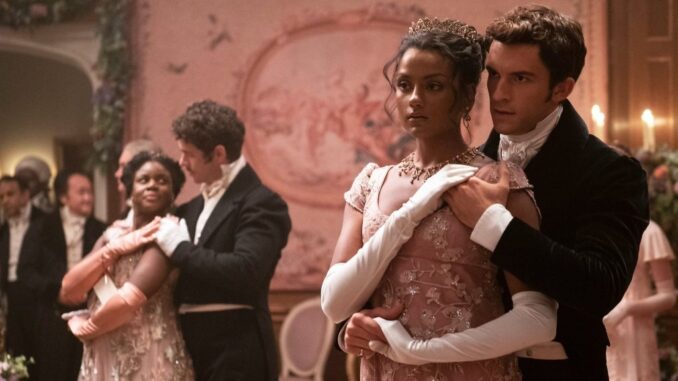
aDearest Gentle Readers, we must discuss a recurring scandal in the Bridgerton universe that has become painfully predictable.
After four seasons of pining, glitzy balls, and string-quartet covers of pop hits, there’s one trope that needs to be retired immediately: the reformed “rake”. It has officially overstayed its welcome.
While the bad-boy-turned-lover-boy arc is a pillar of the romance genre, the show has reached a saturation point where this narrative no longer feels like an organic part of a character’s journey. It feels more like a mandatory uniform we’re forcing every leading man to wear.
When every male lead follows the same path of debauchery before finding “the one,” the redemption frankly loses its impact.
This reliance on the rake persona reached a point of genuine confusion with Colin Bridgerton. To many viewers, Colin’s tour of European women felt fundamentally at odds with his established character. We knew him as the sensitive, hungry, and earnest brother who led with his heart.
Seeing him suddenly adopt a swaggering, brothel-visiting persona felt like a costume he was forced to wear simply because the writers felt a Bridgerton man isn’t a lead until he’s gone through the same rite of passage.
It was a narrative detour that made little sense for his temperament and served only to delay the inevitable, proving that the trope is being used as a crutch rather than a tool for storytelling.
To be clear, this isn’t a matter of slut-shaming the characters — for example, I absolutely adore Benedict, who remains my favourite Bridgerton precisely because his fluid lifestyle feels like an authentic extension of his artistic soul — but rather a critique of how the show applies this bad boy filter to men it simply doesn’t fit.
Beyond the boredom of repetition, this trope is far less progressive than the show seems to think it is. By constantly showcasing these exploits — often explicitly and for no narrative reason — the show reinforces the idea that male growth is only valid if it is preceded by a period of aimless hedonism.
It places the emotional weight of a man’s morality squarely on the woman’s shoulders, suggesting that Daphne, Kate, Penelope or Sophie had to be “special” enough to make a man behave with basic decency.
There is nothing particularly progressive about a woman having to fix or tame a man who has spent years disregarding the feelings of others. It suggests a narrow view of masculinity where a man is only interesting if he has a dark side to conquer.
As we look toward the future of the series, there is a desperate need for a different kind of hero, and Sir Phillip Crane provides the perfect opportunity for this shift. In the world of the Ton, Phillip is a rarity: a kind, steady, and intellectual man who has no interest in the lifestyle of a rake.
For a character like Eloise (tipped to be the focus of Series Five) who has spent her life railing against the shallow performativity and the double standards of society, a reformed rake would be her worst nightmare. She doesn’t need a man who has seen it all and decided he’s finally bored enough to settle down.
She doesn’t need to be taught the ways of the world. She needs an equal — someone whose character development is based on shared interests and genuine kindness rather than a sudden pivot away from a life of vice.
Now, this doesn’t mean there isn’t a place for the trope. I’ll be the first to admit that I love a bad boy storyline. But there’s a time and place for it, and it certainly does not apply to every man.
The most radical move the show could make now is to also embrace the good man. If the series wants to remain the gold standard of televised romance, it must realise that a man doesn’t always need to be a bad boy to be worth watching.
We are ready for heroes who are driven by curiousity rather than conquest, and who don’t need to hide their hearts behind a bottle of brandy to be considered masculine.
It is time for the show to retire the rake and prove that, sometimes, sincerity can be just as romantic as a scandalous past.