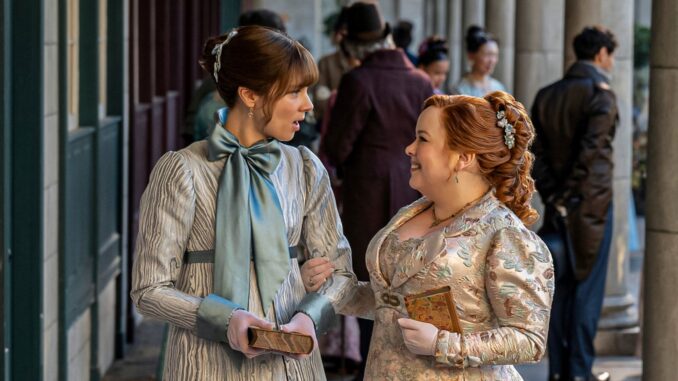
Bridgerton’s female characters defy stereotypes, embracing flaws, ambition, and complexity while challenging societal norms and expectations.
Since its debut in 2020, Bridgerton has captured the hearts and minds of millions, including me. The Regency era show has dazzled with its extravagant ball gowns and heart-pounding romance. But for me, it’s the characters, particularly the women, that continue to break the mold of typical period drama tropes.
In a world where women were historically expected to be passive, Bridgerton flips the script. Female characters like Daphne, Eloise, and Penelope take control of their own destinies, whether through their pursuit of love or independence. They make decisions that are not only flawed but also challenge societal expectations.
Bridgerton: Women as Architects of Their Own Fate
From the very beginning, the show’s female characters have refused to fit neatly into expected roles. They’re not just the love interests or the delicate women awaiting rescue; these women are complex, ambitious, flawed, and unapologetically themselves.
Take Daphne Bridgerton, for example. At first glance, Daphne might seem like the picture-perfect diamond, eager to marry and live out the fairy-tale life society expects of her. However, as the series progresses, Daphne evolves into a character who is not afraid to assert her will. When her brother, Anthony, attempts to force her into an engagement with a man she doesn’t love, Daphne takes matters into her own hands. She punched Nigel Berbrooke, showing the power of standing up for oneself. However, Daphne is not out of the flaw. Compared to other characters in the later seasons, her character lacks rebellion or self-growth, which makes her the least interesting.
Eloise Bridgerton, Daphne’s younger sister, takes this power to the next level. Throughout the first two seasons, Eloise refuses to play the part of the perfect debutante. She scoffs at the idea of marriage being her ultimate goal and dreams of intellectual pursuits, like attending university and becoming a writer.
However, Eloise often struggles to see beyond her own perspective, making her seem somewhat spoiled. For instance, she shows a lack of support and understanding for Cressida’s difficult situation and even ruins her friendship with Penelope in season 2. That also highlights the moral complexities of the characters, which need to be addressed in future seasons.
Kate is introduced as a woman who is independent and sharp-witted and has an unwavering sense of responsibility. She is intent on remaining unmarried to secure her sister’s future. The relationship between Kate and Anthony is built on their verbal sparring and shared sense of duty. She challenges him and puts him in his place, something he is ultimately drawn to. Her primary motivation is ensuring her family’s security and happiness, even when her sister was getting married to her love. This selflessness is a core component of her strength and ultimately leads to a life she deserves.
Penelope’s shift from a passive, often ignored character to a powerful, independent woman who creates her own destiny. Her ability to navigate the social influence is a direct challenge to the idea that women must always remain silent or hidden. As Lady Whistledown, Penelope takes control of her own voice and becomes a formidable force in society, unafraid to speak her truth.
Women Challenging Societal Double Standards in Bridgerton
A recurring theme in Bridgerton is the double standard regarding women’s s*xuality. Women in Regency-era society are expected to maintain a pristine reputation, especially when it comes to their s*xual activity.
Daphne herself is warned repeatedly about her reputation, particularly after she begins a relationship with Simon. The pressure to remain chaste until marriage, and the consequences of sexual freedom, are explored throughout the show.
Marina Thompson, a new addition to the Featherington family, faces the harsh consequences of violating these societal norms. After becoming pregnant out of wedlock, Marina is shunned by society. With that, her prospects for marriage severely diminished, even when she had the potential. This treatment of Marina exposes the s*xual double standard that still exists in society today.
Even Portia Featherington, who is painted as a scheming antagonist, is revealed to be a product of the oppressive system that limits women. Portia’s desperate attempts to secure a good marriage for her daughters are born from the restrictions placed on her as a woman in a patriarchal society.
We can all agree that her character is not perfect. But she is a clear representation of how women, even when they’re flawed, are often simply reacting to a system that has left them with few options. Her character shows how women are just trying to survive in a world that limits their power.
In conclusion, Bridgerton‘s female characters are allergic to being pigeonholed because they reflect the complexity of womanhood. At its core, it is more than just a period drama. It is a progressive take on how women have always been fighting for their voices to be heard.
As we look ahead to Bridgerton Season 4, it’s clear that Bridgerton will continue to showcase these women who won’t be defined by anyone but themselves. What will these complex characters do next? That’s the question I can’t wait to see answered.