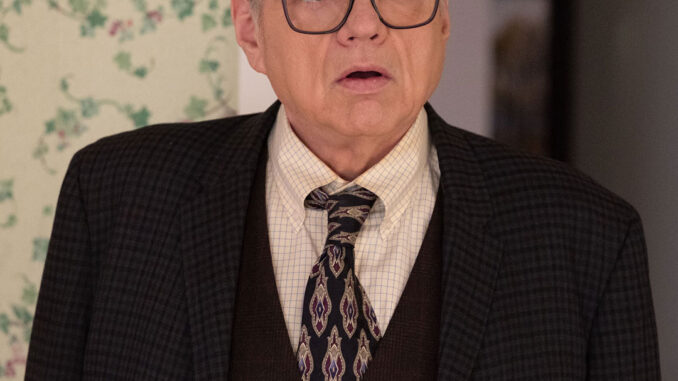
Chicago Med executive producer Allen MacDonald delves into the making of Season 11’s game-changing episode, including which scene was almost very different.
SPOILER ALERT AND WARNING: The following contains spoilers for Chicago Med Season 11, Episode 17. It also contains discussion of suicide.
Fans of Chicago Med have learned Dr. Daniel Charles’ fate—and a whole lot more that they never knew. In “Altered States,” it was revealed that the fan-favorite character portrayed by Oliver Platt survived his stroke. Yet the real challenge was in Dr. Charles’ own mind, as he faced up to everything that had brought him to that point, including the loss of his father.
In the third part of our interview with Chicago Med showrunner Allen MacDonald, we dive into the making of “Altered States.” Allen explains how some of the episode’s most important choices were made, and what inspired this incredibly difficult but also incredibly moving story. Plus, find out what big scene almost turned out very differently.
Brittany Frederick: You wrote “The Book of Charles” and put together this excellent story delving into Dr. Charles’ mindset. Talk about passing the baton to Deanna Shumaker to write “Altered States,” and what made her the right person to bring this plotline home.
Allen MacDonald: To me, she was the natural person to embark on this journey with and share the experience with, because her writing is always very emotionally centered, and moving and human, and humorous, I always say that on Chicago Med, I want people to both laugh and cry when they watch episodes, and it’s ideal if they can do both at the same time. I don’t mean like laugh like comedy or joke; I mean laugh because what you’re seeing on screen is so relatable. That you laugh at it because you’ve been there too.
The episode feels like it checks off pretty much everyone who’s anyone in Dr. Charles’ life. How did you settle on the characters to utilize?
There was a list of characters that we knew we absolutely wanted to delve into. Ripley was very much the first name that popped up, and I wanted to see that.
I wanted to see his mother again. The actor who plays his mother, Deanna Dunagan, is someone I’ve been a fan of for a very long time. She was in a play on Broadway called August: Osage County… and she played a tyrannical mother in that, that makes Margaret Charles look like a kitten. I wanted to work with her again, even though her character was dead. When we killed her off last season, I was already thinking that we’d bring her back… but I obviously didn’t tell her that, because I don’t want to make promises before I know that I can do it.
With an episode where you have dream sequences, that doesn’t really fall under the typical brand identity for Dick Wolf television shows, and so there were a lot of concerns and conversations, about whether we should do this. Much to their credit, Peter Jankowski and Rebecca McGill at Wolf Entertainment were both very supportive of the idea of doing, in essence, dream sequences like this, and they completely believed in us to pull this off. But we had to get permission from Dick Wolf. Rebecca called him, and we were all waiting on pins and needles for what he was going to say. She called him and pitched him this episode, and he replied, I love it, let’s do it. And so I owe them all a big thank-you for their faith.
What made that the right creative device to use to tell this story? Especially since, as you said, it’s so atypical to the world in which you’re working.
Everything I do is a homage to something I loved. I watched an NBC medical show in the 80s called St. Elsewhere, and there was an actor on that show named Howie Mandel, who’s now known as the judge on America’s Got Talent, but he played a doctor named Dr Wayne Fiscus on that show. And they had an episode called “After Life,” where he got shot in the heart in the ER and Dr. Craig, played by William Daniels, did heart surgery on him during the whole episode. The episode took us into his spirit or whatever as he went to heaven, hell and purgatory, and he interacted with all these dead characters from the past.
That was what inspired me to do this episode. But I obviously I didn’t want to do the heaven, hell, purgatory. I wanted to do my own version of it, which is more based in the idea that Dr. Charles, who’s an extremely talented shrink, has to shrink himself and the only way for him to do that is in his dream.
The entire two-part story arc culminates in the scene between Dr. Charles and his father Lucas, played by Elden Henson. Can you walk through that scene in particular?
When I had Charles tell Anna the story of when he found his father dead from suicide at the end of Season 10, I was already planning on seeing a version of that in a dream sequence in this episode, so that was very meaningful and important to me to do. Because I think if you encounter something traumatic like that, you probably spend your life playing it through your mind, wishing you had gotten there in time and that you had been able to save him.
It’s wish fulfillment, and I wanted the audience to experience that wish fulfillment with Charles, and then suddenly have the garage door close and the car start, and the exhaust start coming through the hose again into the car and realize the obvious. But the audience is hopefully hoping for something different… And I was just moved by the idea of Charles talking to his dad, who he is now older than, and to see that visual of the father being younger than the son,.
It was really important to me that the father speak in patterns that we are used to Charles speaking in. We hear the dad call him “buddy,” we hear call him “pal,” which are things that Oliver’s been doing since long before I came on the scene. Most importantly, Lucas says to him, I need you to remember three things, and then he goes through it, and that’s something that Charles does a lot. In fact, he does in Episode 18 that’s coming up.