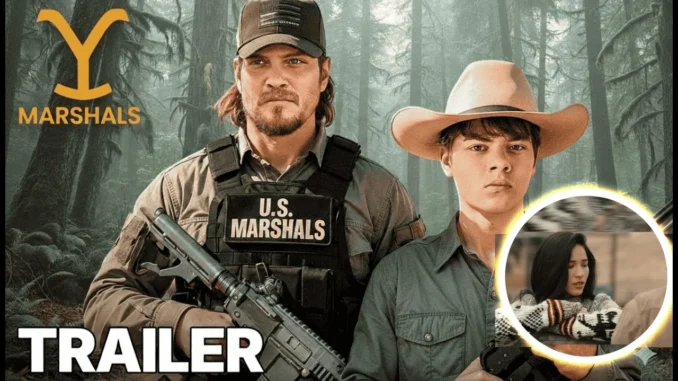
Why Yellowstone Fans Might Boycott the Marshal Spin-off: The Ultimate Internal Fandom Conflict
Yellowstone isn’t just a show; it’s a cultural juggernaut. It’s a modern-day myth about land, legacy, and the brutal lengths one family will go to keep what’s theirs. But as the “Sheridan-verse” expands faster than a Montana wildfire, a storm is brewing. The announcement of the Marshal spin-off—rumored to dive into the historical or contemporary world of law enforcement within the franchise—has hit a nerve. Instead of the usual cheers, there’s a growing murmur of “enough is enough.”
But why? Why would a fanbase that stayed loyal through behind-the-scenes drama and scheduling nightmares suddenly consider a boycott? It’s not about the acting or the cinematography; it’s about a deep-seated internal conflict between what the fans love and where the franchise is heading.
The Dilution of the Dutton Legacy
One of the primary reasons fans are whispering the “B-word” (boycott) is the fear of franchise fatigue. When 1883 dropped, it was a masterpiece. When 1923 arrived, we were hooked. But now, with 6666, 1944, 2024, and this new Marshal project, the well is starting to run dry.
Is it possible to have too much of a good thing? Absolutely. When you spread a story too thin, you lose the “prestige” feel that made the original series a hit. If every side character or historical footnote gets a ten-episode arc, the stakes start to feel lower. Fans aren’t just viewers; they are stakeholders in the Dutton lore. If the Marshal spin-off feels like a “filler” show, the audience might just decide to sit this one out to protect the integrity of the original story.
The “Hero vs. Anti-Hero” Paradox
Let’s be real: we love the Duttons because they are “bad” people we root for. They operate in the gray areas of the law. The introduction of a series centered entirely on Federal Marshals or traditional law enforcement creates a moral friction.
-
The Conflict: Fans are used to seeing the “badge” as the antagonist.
-
The Risk: A show about Marshals might feel like a generic police procedural dressed in a cowboy hat.
If the spin-off tries to make us root for the very people who would realistically be trying to put John Dutton in prison, it creates a psychological disconnect. You can’t ask an audience to cheer for the wolf and the shepherd at the same time.
Behind-the-Scenes Fatigue and Creator Distraction
Taylor Sheridan is a powerhouse, but even a titan has only 24 hours in a day. The ongoing drama surrounding Kevin Costner’s exit from the main series left a bitter taste in many mouths. Many fans feel that the “mothership” (the original Yellowstone) was sacrificed at the altar of endless spin-offs.
Is Sheridan Stretched Too Thin?
There is a growing sentiment that the writing quality fluctuates when a creator has ten different shows in production. Fans are worried that the Marshal spin-off is just another “content grab” rather than a story that needs to be told. When the creator’s focus is divided, the dialogue loses its punch, and the plots become predictable. A boycott wouldn’t necessarily be a protest against the new show, but a demand for quality over quantity.
The “Marshal” Identity Crisis: History vs. Modernity
The rumors regarding the timeline of the Marshal series have been all over the map. Will it follow the legendary Bass Reeves? Or is it a modern-day law enforcement drama?
The Historical Burnout
While 1883 was a gritty, beautiful look at the West, fans are starting to crave the modern-day ranch politics that made the original show a phenomenon. If the Marshal series is another period piece, it risks blending into the background of 1923 and 1944.
The Modern Procedural Trap
Conversely, if it’s a modern show, it risks becoming CSI: Montana. The magic of Yellowstone is the ranch. Take the action away from the “Big Sky” land-grab politics, and you’re left with a standard law enforcement show. Fans are asking: “If I wanted to watch a show about Marshals, wouldn’t I just watch Justified?”
The Cost of Streaming Subscriptions
Let’s talk about the elephant in the room: the wallet. To keep up with every corner of the Yellowstone universe, fans have to juggle multiple streaming services.
-
Paramount Network for the original.
-
Peacock for past seasons.
-
Paramount+ for the spin-offs.
This “fragmentation” is frustrating. Forcing fans to pay for another service just to see one spin-off is a risky move. A boycott is often the only way fans can “vote” against these corporate streaming wars.
The Absence of the “Dutton Factor”
The secret sauce of this franchise is the family dynamic. The toxic, loving, violent, and fiercely loyal Dutton clan is what keeps people coming back. The Marshal spin-off, by definition, moves away from the family core.
Without a Beth Dutton to drop verbal nukes or a Rip Wheeler to take people to the “train station,” does the show even feel like Yellowstone? Fans are skeptical that a cast of lawmen can provide the same visceral thrill as a family that operates outside the rules.
Is the “Western” Genre Being Over-Saturated?
Success breeds imitation. Since Yellowstone exploded, the market has been flooded with “Neo-Westerns.” By launching yet another one, Paramount risks making the genre feel mundane. If every show features a rugged man on a horse staring at a sunset, the imagery loses its power.
The Internal Fandom Civil War
There is a divide within the community. On one side, you have the “Sheridan Loyalists” who will watch anything he touches. On the other, you have the “Dutton Purists” who believe the story should have ended with John Dutton.
The Marshal spin-off is the flashpoint for this conflict. Purists see it as a distraction that delayed the conclusion of the main series. The boycott isn’t just about the new show; it’s a “civil war” over the direction of the brand.
Authenticity vs. Commercialism
The original Yellowstone felt like a passion project. It felt authentic to the Montana dirt. The recent spin-offs, however, are starting to feel like corporate products designed to hit specific demographics.
-
Authenticity: Gritty, slow-burn, character-driven.
-
Commercialism: Fast-paced, cliffhanger-heavy, designed for viral clips.
If the Marshal spin-off leans too far into the “Hollywood” version of the West, the core audience—the people who actually live in “flyover country”—will be the first to turn it off.
The Danger of Rewriting History
If the spin-off focuses on historical figures, there is always the risk of modern sensibilities clashing with historical reality. Fans of this genre typically enjoy a level of historical grit. If the show feels “sanitized” or “preachy,” it will alienate the very demographic that made Yellowstone a hit in the first place.
What Could Stop the Boycott?
It’s not all doom and gloom. The “boycott” is currently a scenario fueled by anxiety, but it can be averted.
-
Direct Ties: If the Marshals have a direct, high-stakes connection to the Dutton history.
-
Top-Tier Casting: Bringing in a lead with the gravitas of Costner or Harrison Ford.
-
Writer Focus: Proving that the scripts aren’t being “ghostwritten” by a room of executives.
Conclusion: A Fandom at a Crossroads
The potential boycott of the Marshal spin-off is a symptom of a larger issue. Fans feel unheard. After years of investment, they want a satisfying conclusion to the stories they already love before they are asked to start a new one. The internal conflict is simple: we love this world, but we don’t want to see it ruined by over-expansion.
Whether the Marshal series becomes a hit or a footnote depends entirely on whether it can capture the “soul” of the West, or if it’s just another badge in a crowded room.