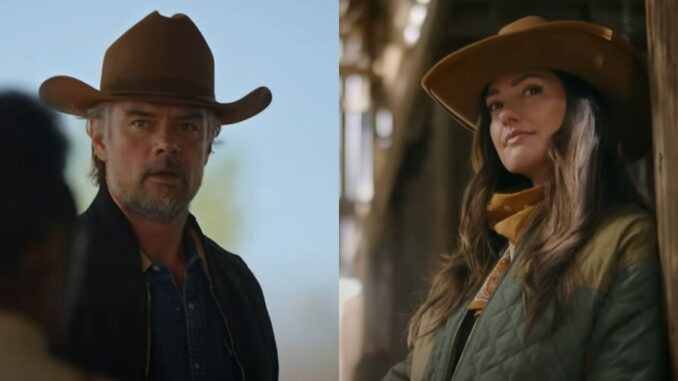
A New Western Riding Into the Streaming Frontier
In the ever-evolving world of streaming television, few genres have experienced a revival as dramatic as the modern Western. Over the last decade, audiences have rediscovered their appetite for stories set against sweeping landscapes, tales of family legacies, and morally complex characters navigating rugged frontiers.
Now, a new contender has entered the conversation: Ransom Canyon.
Even before its full release, the Netflix drama has sparked a surprisingly intense debate online and among critics:
Could Ransom Canyon become the next cultural phenomenon like Yellowstone?
The comparison may sound bold. After all, Yellowstone has dominated television ratings, inspired multiple spinoffs, and redefined the modern Western drama. Yet early reactions to Ransom Canyon suggest that Netflix may have found a series capable of capturing a similar blend of romance, frontier politics, and emotional storytelling.
Still, not everyone is convinced.
What Ransom Canyon Is About
Set in the rugged beauty of Texas Hill Country, Ransom Canyon revolves around several ranching families whose lives are tightly interwoven through loyalty, rivalry, love, and land disputes.
At the heart of the story is Staten Kirkland, a stoic rancher determined to protect his family’s legacy as outside developers threaten to reshape the region. His emotional journey—marked by loss, resilience, and a complicated romantic history—forms the backbone of the show.
Alongside him is Quinn O’Grady, a longtime family friend who returns to town carrying secrets and unresolved feelings. Their relationship provides the show’s central romantic tension, a storyline that many viewers say differentiates Ransom Canyon from more politically driven Western dramas.
The show also explores multiple subplots:
-
rival ranch families fighting for control of land
-
generational conflicts between tradition and modernization
-
small-town scandals and buried secrets
-
romantic entanglements that complicate business and loyalty
It’s a formula that blends Western drama, soap opera, and romance, giving the series a unique tonal mix.
Why People Are Comparing It to Yellowstone
The comparison between Ransom Canyon and Yellowstone didn’t emerge by accident.
For many viewers, the similarities are immediately recognizable.
1. Ranching Dynasties and Land Battles
Both shows center on powerful ranch families fighting to protect their land against corporate developers, political interests, and rival landowners.
In Yellowstone, the Dutton family struggles to maintain control of their massive Montana ranch. In Ransom Canyon, the stakes are similar—though the conflict unfolds through multiple ranching families rather than one dominant dynasty.
2. Big Landscapes, Big Emotions
Sweeping cinematography has become a hallmark of modern Western television. Like Yellowstone, Ransom Canyon uses expansive landscapes to emphasize the emotional weight of its characters’ choices.
Dusty ranch roads, golden sunsets, and wide-open valleys aren’t just backdrops—they’re symbols of identity and heritage.
3. Family Legacy at the Core
Both series revolve around a central theme: What does it mean to inherit land, tradition, and responsibility?
Characters in both shows wrestle with questions about whether preserving tradition is worth the sacrifices it demands.
4. Complex Characters Instead of Clear Heroes
Another similarity lies in moral ambiguity. Neither show relies on simple heroes or villains.
Characters often make decisions that are ethically questionable, driven by survival, loyalty, or revenge.
Where Ransom Canyon Feels Different
Despite the inevitable comparisons, many critics argue that Ransom Canyon isn’t trying to copy Yellowstone at all.
Instead, it’s carving out its own identity.
1. A Stronger Focus on Romance
One of the biggest differences is tone. While Yellowstone often leans into crime, politics, and violent confrontations, Ransom Canyon emphasizes relationships and emotional storytelling.
Some critics have even described it as “a Western romance epic.”
The slow-burn dynamic between Staten and Quinn gives the show a more intimate feel than many Western dramas.
2. Multiple Family Perspectives
Rather than focusing primarily on one dominant ranch family, Ransom Canyon explores several families whose interests collide.
This structure allows the show to explore a wider range of viewpoints about land ownership, modernization, and community.
3. Small-Town Drama Energy
Another element that distinguishes the series is its almost soap-opera-like energy.
There are secrets, betrayals, love triangles, and long-standing grudges—sometimes unfolding in ways that feel closer to small-town drama than gritty Western crime.
For some viewers, that’s exactly what makes it compelling.
Early Audience Reactions
The internet debate about Ransom Canyon has grown quickly.
On fan forums and social media, reactions have ranged from enthusiastic praise to cautious skepticism.
Some viewers have called the series:
-
“Yellowstone meets romance drama.”
-
“A cozy Western with emotional depth.”
-
“Netflix’s answer to ranch TV.”
Others, however, argue that comparing it to Yellowstone sets unrealistic expectations.
A few critics say the pacing is slower and the stakes feel more personal rather than explosive.
Yet that may actually be the point.
Not every Western needs to be about violent power struggles.
Sometimes, the drama lies in the quiet conflicts of community, loyalty, and love.
Why Western TV Is Suddenly Everywhere
The debate around Ransom Canyon also reflects a larger trend: the return of Western storytelling in modern television.
For years, the genre seemed outdated. But recently, audiences have rediscovered its appeal.
There are several reasons why.
Escapism in a Complicated World
Wide landscapes and rural settings offer a form of escapism that urban dramas can’t always provide.
Viewers are drawn to the idea of simpler environments—even if the characters’ lives remain complicated.
Timeless Themes
Western stories explore universal themes:
-
land ownership
-
identity
-
family loyalty
-
survival and change
These themes resonate regardless of time period.
A New Generation of Western Heroes
Modern Western shows tend to avoid the classic “lone gunslinger” trope.
Instead, they focus on flawed, deeply human characters navigating complicated moral landscapes.
Netflix’s Strategy Behind the Series
For Netflix, Ransom Canyon represents a strategic move.
Streaming platforms are increasingly competing for niche audiences, and Western drama has become one of the most loyal television fan bases.
By producing a romantic, character-driven Western, Netflix may be attempting to capture viewers who enjoy both:
-
frontier storytelling
-
relationship-centered drama
If the show succeeds, it could open the door for more Western content on streaming platforms.
Can It Actually Become the Next Yellowstone?
That’s the million-dollar question.
The truth is, cultural phenomena like Yellowstone are difficult to replicate. Its success came from a perfect mix of timing, storytelling, and star power.
But Ransom Canyon may not need to replace it.
Instead, it could occupy a different space within the same genre—a softer, more emotional take on ranch-country drama.
And in the streaming era, that might be enough.
After all, television audiences are no longer limited to one defining show per genre.
There’s room for multiple Western stories to thrive.
The Verdict So Far
At this early stage, Ransom Canyon remains something of a question mark.
It has the ingredients of a successful drama:
-
compelling relationships
-
dramatic landscapes
-
family conflicts
-
romantic tension
-
generational stakes
Whether it evolves into a cultural juggernaut like Yellowstone remains to be seen.
But one thing is certain:
The conversation has already started.
And in the crowded world of streaming television, that may be the most important victory of all.