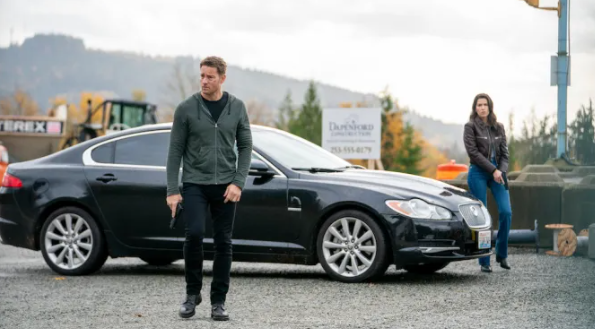
Colter Shaw is on the run. Tracker returned to CBS on Sunday, putting Colter on the opposite end of the chase this time. Instead of hunting down a missing person, he’s doing everything he can to avoid being caught himself after he’s framed for a crime he didn’t commit.
It’s a storyline that executive producer and star Justin Hartley has been looking forward to developing for quite some time. After introducing the audience to the procedural over the first two seasons, now seemed like the time to throw a small wrench in their expectations for what Tracker could be.
“I just think it’s a really great storyline, and it’s a cool thing to do something different that we haven’t done before. It’s cool to see Colter on the run, as opposed to searching for something. It’s just a complete upside down, which I love,” he told Deadline.
In the interview below, Hartley discusses Sunday’s episode and the maturation of his network procedural over the course of these three seasons.
ou’ve been talking for quite a while about wanting to do this story where Colter gets framed, so it’s fun to see that come to life. Can you tell me how you started to develop this particular plotline?
JUSTIN HARTLEY: A lot of these things happen when you’re thinking about a long run of the show, and I didn’t start thinking about a long run of the show until it was pretty obvious that people were enjoying the show, and a lot of people were watching it, and they wanted more. Then you sit there, and you go, ‘Hmm, okay, well, man, if we have to think of something other than just every week he gets himself into a bind and is resolved in 42 minutes, which can be fun and exciting as well…but there’s something really cool, in my opinion, about also tying in a serialized element that pays off. I guess it pays off for loyal audiences that have watched from the beginning and also doesn’t confuse people that are tuning in for the first time. So it’s a very delicate thing.
I guess it was a couple of years ago, or maybe a year and a half ago. I was like, what’s interesting? This guy’s got all of these skills. He helps locate people. What if it was turned on its head, and he had to use all of those skills and life experiences and expertise in certain things that most people don’t have in order to escape or avoid getting caught or hide…I think it allows for really cool reintroductions of characters that come in and can kind of help him in ways [that] are not so obvious. In our episode, the authorities are coming in, and they’re raiding Reenie and Randy’s place, and taking everything, and so he’s got to sort of reach out to someone else. It’s not so obvious. So I just think it’s a really great storyline, and it’s a cool thing to do something different that we haven’t done before. It’s cool to see Colter on the run, as opposed to searching for something. It’s just a complete upside down, which I love.
So how did you figure out the pacing within the procedural for this serialized element?
HARTLEY: I think it’s important that we’re also, at the same time, being true to the show. I always say this. Everyone’s so busy, and for someone to take an hour out of their day or their night, or even if they’re watching it on a rerun or streaming, or however people consume this stuff. It’s an hour of people sitting there and watching this thing, and we’re asking them to take time out of their lives and and we’re hoping that we entertain them. So I think it’s important to be consistent with what Tracker is and not all of a sudden do an animated episode or a musical or something like that. You watch the show, and even though the serialized element is a bit different than what you’re used to, it’s very familiar tonally. It’s a very familiar thing when you watch Tracker. There’s got to be a payoff at the end of every hour of television that we’re showing people. That’s sort of what we do.
And then, to be honest with you, the way that our show works is so unique. We’re all in different places. All of the producers are in different places. We’re not together. So Elwood does his thing, Ken does his thing, and then I do my thing, and my thing is on set and with the crew and on the day, and things just come up…You have a script, and it’s written a certain way. Then, a lot of that stuff is figured out once you see it, and you hope that you’re right. I think I understand the tone of the show and what the show is, and why people like the show, why I like the show, what gets me excited about the character, and when things are not working that way, I have to change them, and I just hope that I’m right. I’m not right all the time. Hopefully, most of the time, I have my finger on the pulse.
DEADLINE: How do you feel like you’ve settled into the show over the course of three seasons to be able to operate in that manner?
HARTLEY: I’ve been lucky that, I guess, from the very beginning of my career, it was sort of a slow wade into the deep waters. I never really got thrust into the deep end. It was almost like a beach, like an ocean, instead of the deep end of the pool and a diving board. I just sort of waded in. I was at my ankles, my knees, my hips, my shoulders. Next thing you know, I’ve never really felt underwater. I love the work. I absolutely adore the challenge, and I get an adrenaline rush from just being on set and knowing that this decision that I’m sure of is hopefully the right decision, and only time will tell. I just love it. And our show changes a bit. I think our show, again, doesn’t change in terms of an audience is going to watch and be like, ‘What have they done with these characters,’ but changes in terms of it advances, and he does this thing where he adapts.
Every experience that he has, I think it changes him in a way. so you can watch how he would react to something maybe a year ago, and right now, how he would react to that thing is different, just based on his life experiences, which is very human, which is what you do. It’s what prevents people from being so naive. It’s like you have these life experiences and you go, ‘Aha, you know what? I’m not going to do that again.’ He evolves. I think that’s one of the things about the character that that I love so much, that gets me excited to play every day. It’s not the same thing every single time. It’s like, ‘Okay, this guy’s a little bit more evolved now than he was eight months ago because of these experiences that he’s gone through.’ The challenge is then [developing] a very similar event, just a year later, and he reacts differently, and in a more efficient way. He’s older, wiser, better at his job, more seasoned. He’s seen more things, and it’s just like real life.
I also feel like the show has really grown in scale a bit, too. I mean, it’s always had action, but there was a car going off the side of a cliff in the midseason finale. Have you been trying to up the ante in that way as well?
HARTLEY: Well, one of the important things to me, and I think all the other producers that I talked to…one of the things that we want to make sure that we maintain with the show is this idea of danger. I’m not really interested in a show where you’re just sort of always sure that the guy’s okay. I’m not saying that we’re going to kill Colter in the next three episodes or something, but we definitely want to show him in danger and injured. He’s human. He bleeds just like the rest of us. So he gets in a car crash, it’s not great for him. He’s not just walking away and, ‘Well, thank God I was wearing my seatbelt. My car went over a cliff.’ No, the dudes messed up.
That goes for his mental health, as well. All this stuff he’s seen, I think you’ll start to see, — well, here’s a breaking news. I haven’t even told anybody this. I was thinking about this the other day, just sort of sitting with the character and thinking about all of this stuff that he’s seen, and he has this really great attitude about who people are and what they really want. In their private moment, what they really think. He thinks that people are really, in general, good, but then you take that and you mix it with everything that he’s seen, and I’m thinking to myself, ‘Man, I mean, he’s constantly seeing people at their absolute worst. People being selfish, people being greedy, people murdering other people, people kidnapping other people, taking advantage of women, people taking advantage of children, all of this awful stuff. Maybe he starts to crack a little bit, because I think anybody would.’
So have you thought about what that might look like for Colter to be seriously injured or incapacitated in some way that would really set him back?
HARTLEY: Oh, yeah, that’s so funny that you that you bring that up. That is something that I’ve absolutely thought about, and what would that look like. People are still in in peril and in danger and needing his help, and maybe he’s not physically able to do that. Or, it could be a geographic thing, but I think being physically unable, or mentally just not being there, not being focused…I think everyone gets overwhelmed from time to time.
He’s also got some interesting emotional beats this episode. He’s really leaning on Billie at a time when he doesn’t know who he can trust. How does he feel watching her get arrested for him?
HARTLEY: There was a lot of really long conversations that I had with Sofia about that. He’s always making sure everyone else is okay. I think we all have people like that in our lives, and it’s usually your elders, where you just sort of, as you grow up and you’re a kid, you never really think about your parents necessarily not being okay. Then you get to be their age [and], when you remember them back in the day when you were eight or whatever, you’re going, ‘Oh man, I wonder if they were dealing with all this stuff,’ and you think about it, you go, ‘Not only were they dealing with all this stuff, but they were dealing with all this stuff without the technology that we have. They didn’t have, you know, the access to all this stuff that we had. They were doing the best they could.’ So, yeah, there’s a moment at the end of the episode that we played with for quite a long time, where she comes in and she asks Colter…she says to him, ‘How are you?’ That was really important to me, that that was in there. She’s got to ask him how he’s doing. No one asks him how he’s doing. No one ever asks him that.
How might we continue to dig into Colter’s family backstory as we enter the back half of the season?
HARTLEY: More towards the end of Season 3, I would say, we get a lot of those answers. I don’t know if it’s a complete resolve, like ‘Everything’s okay, and now I feel better,’ but it’s information that he needed in order for him to move on with his life and go about his business and put that to bed, or at least be at peace with the details, knowing that he has the details, because for so long, he just didn’t have the details.
You also just got renewed for Season 4 recently. Have you started to ruminate on where you’ll go with it?
HARTLEY: Well, I think he just has such an interesting life. I really love this character, and I think there’s so much more to do with him. I get the luxury of being him on camera and dealing with this character every day…He is ever evolving, and it’s such a cool thing to watch. He’s a grown man, but you kind of see him growing up in his adulthood. So we’ll just continue that through Season 4. We’re not going to make any huge, big changes, because I think people really like the show, and they find comfort in that. But we certainly have to keep it fresh.
We have a bunch of returning characters. We have characters that can return in Season 4, which I’m looking forward to. One of the great things about being renewed early and getting a Season 4 and having a show this so many people love and watch is that you’re never really wondering if you’re going to get picked up. It’s great for our writers, because they can write long term storylines as opposed to short bursts. We’re not really worried about, I guess, not having any more episodes. So, we have so many wonderful characters that we’ve introduced on the show that I would love to bring back, and I think that we will. So that’s what I’m looking forward to in Season 4 as well.
Any you can name now?
HARTLEY: I mean, I can tell you who I would love to bring back. I would love, of course, to bring Sofia back. I would love to bring Jensen back, and we will. There are a couple of really great detectives we’ve had on as guest stars with the intention of just being in one episode. He can revisit that town, maybe work with that person again. We’ve done that before. There’s a good half a dozen, or maybe 10 actors I can think about off the top of my head. That’ll be fun for people.