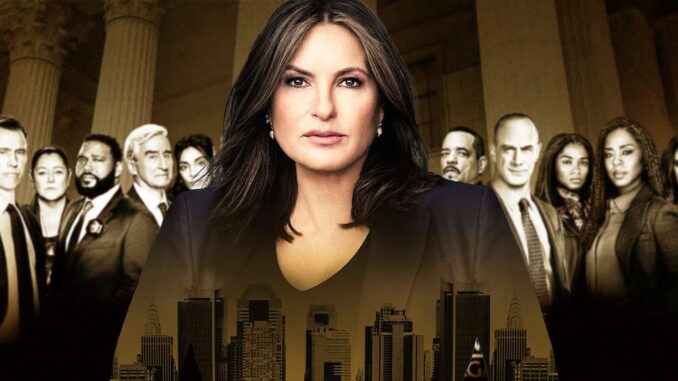
The Unbreakable Case File: Will SVU 2025 Still Outperform Chicago P.D. and Criminal Minds?
The siren’s wail, the cold glint of a badge, the stark moral ambiguities of justice – the police procedural has long been a cornerstone of television, a comfortingly familiar yet perpetually evolving genre. In this crowded landscape, three titans have carved out distinct territories: the victim-centric gravitas of Law & Order: Special Victims Unit (SVU), the gritty street-level intensity of Chicago P.D., and the chilling psychological deep-dive of Criminal Minds. But as we peer into the not-so-distant future of 2025, a crucial question arises: can the venerable, battle-scarred SVU, now decades into its run, still hold its own against its formidable, often younger, rivals? The answer, I believe, lies in its unique, almost alchemical, blend of cultural relevance, iconic character development, and a narrative flexibility that few shows can match.
Law & Order: SVU isn’t just a show; it’s a cultural fixture, a weekly ritual for millions, and a television phenomenon that has transcended mere entertainment. Its strength, even into 2025, will continue to be its singular focus: the victims. While other procedurals chase culprits or unravel forensic puzzles, SVU zeroes in on the often-unspeakable trauma of sexual assault and abuse, giving voice and agency to survivors. Imagine a hypothetical SVU episode in 2025, still “ripped from the headlines,” perhaps exploring the intersection of AI and non-consensual deepfakes, or the complexities of consent in virtual reality spaces. The core, however, remains unchanged: a meticulous, empathetic investigation led by Olivia Benson, who isn’t merely a character but an enduring archetype – the compassionate yet steely advocate whose wisdom has been forged over countless seasons of tragedy and triumph. Her evolution from a rookie detective to a captain, and then to a beloved mentor figure, provides a narrative spine that grounds the show regardless of the topical issue. This unwavering commitment to a sensitive, vital subject matter, championed by an irreplaceable icon, grants SVU a gravitas and an emotional connection with its audience that purely action-driven or purely psychological dramas often struggle to replicate over such an extended period. It’s television’s equivalent of a seasoned marathon runner; it knows its pace, understands its endurance, and commands respect simply by showing up.
In stark contrast to SVU’s methodical, victim-focused approach stands Chicago P.D., a show built on adrenaline, moral ambiguity, and the visceral thrill of urban policing. P.D. thrives on the immediacy of the moment: the rapid-fire dialogue in a squad car, the heart-pounding foot chase through dark alleys, the ethical tightropes walked by characters like Hank Voight, who often skirts the very edge of the law to achieve justice. By 2025, Chicago P.D. will continue to deliver on its promise of high-octane drama, showcasing an ensemble cast battling real-world threats from gang violence to political corruption within the bustling, unforgiving landscape of the Windy City. Its appeal lies in its gritty realism (or at least, its highly dramatized version of it) and its willingness to delve into the complicated, often messy, dynamics of law enforcement on the streets. However, this very strength can become a potential vulnerability. In an ever-evolving socio-political climate where the narrative around policing is under constant scrutiny, *P.D.*’s brand of “ends justify the means” justice might find itself navigating increasingly choppy waters. While it will undoubtedly maintain a dedicated fanbase drawn to its action and character conflicts, its ability to “outperform” SVU might hinge on its capacity to evolve its portrayal of policing without sacrificing its core identity, a balancing act that requires delicate precision.
Then there’s Criminal Minds, a show that has, for years, dragged viewers into the darkest corners of the human psyche. Where SVU champions empathy and P.D. celebrates direct action, Criminal Minds dissects motive. Its strength lies in its procedural innovation – the behavioral analysis unit, profiling serial killers, and the chilling, often disturbing, psychological games played between predator and profiler. By 2025, Criminal Minds, whether in its original form or a renewed iteration, would still be fascinating audiences with its intricate puzzles and its exploration of abnormal psychology. Its illustrative power comes from making the intangible tangible: how seemingly disparate clues connect to paint a picture of a killer’s mind. The show offers a unique kind of intellectual puzzle, combined with genuine horror elements, making it distinct from its procedural counterparts. Yet, its reliance on the “monster of the week” formula, while effective, can also lead to a degree of predictability. For it to truly outperform, or even keep pace with SVU, it would need to continually innovate its narrative structure, perhaps by delving deeper into the long-term psychological impact on its profilers or exploring new frontiers of criminal psychology in an increasingly digitized world.
Ultimately, “outperform” in 2025 will be a nuanced metric, encompassing not just raw viewership numbers but streaming longevity, cultural resonance, and continued critical discussion. Here, Law & Order: SVU possesses an almost insurmountable advantage. Its sprawling library of episodes makes it a binge-watcher’s paradise, constantly attracting new audiences discovering its enduring power. Its themes, while specific, are universally human, ensuring its relevance across generations. Olivia Benson, by 2025, will be more than just a character; she’ll be a television institution, her very presence a comfort and a guarantee of storytelling that matters. While Chicago P.D. will continue to thrill with its visceral action and Criminal Minds will intrigue with its psychological depths, SVU’s unique positioning as a show that combines a detective procedural with profound social commentary, all anchored by one of television’s most iconic characters, solidifies its claim to continued dominance. It’s a testament to its creators that a show so focused on human vulnerability could become so invulnerable itself. In 2025, the sirens of SVU will still ring loudest, a familiar, enduring call for justice echoing through the digital landscape.