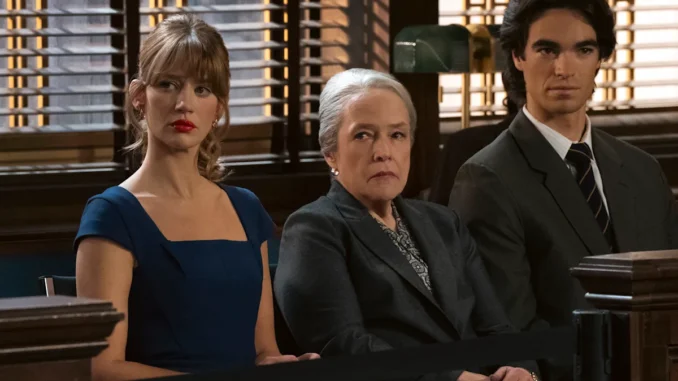
In Episode 11 of Season 2 of the hit legal drama Matlock, titled “Tail Lights,” the series delivers one of its most emotionally layered episodes yet. What initially appears to be a straightforward hit-and-run case slowly unfolds into something far deeper — a meditation on memory, guilt, and the blurred lines between legal justice and moral responsibility.
“Tail Lights” doesn’t rely on explosive courtroom theatrics. Instead, it takes the audience down a dimly lit highway of doubt and reflection, where every testimony feels like a flicker of headlights in the dark. By the time the episode reaches its conclusion, viewers are left contemplating not only the outcome of the case but also the emotional cost of truth.
A Case That Begins With a Flicker of Red
The episode opens on a rainy suburban street at night. A cyclist is struck by a car that disappears into the darkness, leaving behind nothing but a pair of fading tail lights.
This single visual becomes the symbolic anchor of the entire episode.
When the case arrives at the firm, Madeline Matlock, played with sharp intelligence by Kathy Bates, immediately senses that the situation is more complicated than a routine hit-and-run. The accused driver, Daniel Hargrove, insists he never saw the cyclist.
But as Matlock begins to examine the evidence, she notices something unsettling: every witness remembers the accident slightly differently.
Different car colors.
Different speeds.
Even different weather conditions.
The truth, it seems, is hiding somewhere between those fading tail lights.
Matlock’s Strength Lies in Observation
One of the defining traits of the modern Matlock reboot has been its focus on observation rather than intimidation. Unlike many legal dramas where attorneys dominate with dramatic speeches, Matlock often wins by quietly noticing what others ignore.
In “Tail Lights,” that skill is pushed to the forefront.
While younger attorneys at the firm focus on forensic data and surveillance footage, Matlock revisits the scene of the accident herself. She stands at the intersection late at night, watching the flow of cars.
That’s when she notices something critical: the streetlights create reflections on wet pavement that distort how vehicles appear from certain angles.
In other words, witnesses might genuinely believe they saw something that never actually happened.
The episode subtly explores a fascinating concept: human memory is unreliable, especially under stress.
The Emotional Core: A Daughter Looking for Answers
Parallel to the legal investigation is the emotional story of the victim’s daughter, Emily Torres.
Emily isn’t interested in compensation or publicity. She simply wants to know what happened to her father.
Her scenes with Matlock are some of the most powerful moments in the episode. Rather than offering empty reassurances, Matlock speaks with quiet honesty.
At one point she tells Emily:
“Sometimes the truth doesn’t arrive like a verdict.
Sometimes it comes in pieces… and you have to decide which ones you can live with.”
It’s a line that perfectly captures the philosophical tone of the episode.
A Courtroom Strategy That Turns Expectations Upside Down
By the time the trial begins, the audience expects Matlock to deliver a dramatic cross-examination that exposes the real culprit.
But the show subverts that expectation.
Instead of accusing a specific person, Matlock dismantles the reliability of every witness one by one.
She demonstrates how lighting, distance, and stress alter perception. Dash-cam footage from nearby vehicles appears to support multiple conflicting accounts.
The courtroom grows increasingly uneasy.
If no one can be certain what they saw… can anyone truly be guilty?
This tension builds toward one of the episode’s most surprising moments.
The Twist Hidden in Plain Sight
Near the end of the trial, Matlock introduces a seemingly insignificant piece of evidence: a mechanic’s report about the accused driver’s car.
The report shows that the vehicle’s right tail light had been broken before the accident.
Yet every witness testified they saw two glowing red lights.
The implication is devastating.
The car they saw could not have been Daniel Hargrove’s.
The courtroom falls silent as the realization spreads: the real driver may never have even realized they hit someone.
Justice vs. Closure
Rather than ending with a triumphant arrest, “Tail Lights” takes a more introspective approach.
The charges against Hargrove are dismissed, but the identity of the actual driver remains unknown.
In many legal dramas, this would feel unsatisfying. But here, it reinforces the episode’s central theme: justice is not always neat or complete.
In the final scene, Matlock meets Emily once more.
She explains what happened and admits the truth may never fully emerge.
Emily quietly replies:
“At least now I know what didn’t happen.”
It’s a small comfort, but sometimes that’s all people get.
Kathy Bates Delivers Another Masterclass
The emotional weight of “Tail Lights” rests largely on the performance of Kathy Bates, and she carries it effortlessly.
Her portrayal of Matlock continues to redefine what a television legal hero can look like. She isn’t flashy or domineering. Instead, she radiates patience, intelligence, and subtle humor.
In this episode especially, Bates demonstrates remarkable restraint. Much of her performance happens in silence — thoughtful pauses, knowing glances, and quiet deductions.
It’s proof that compelling television doesn’t always require dramatic monologues.
Sometimes a raised eyebrow says more than a five-minute speech.
The Show’s Cinematography Shines
“Tail Lights” also stands out visually.
The episode leans heavily into nighttime imagery: wet roads, glowing brake lights, and reflections in puddles. These visuals reinforce the episode’s themes of distortion and uncertainty.
Several scenes are shot from inside moving cars, with blurred lights passing by the windows.
The effect is almost hypnotic — viewers experience the same confusion the witnesses might have felt during the accident.
It’s an understated but effective storytelling technique.
Why “Tail Lights” Might Become One of the Season’s Best Episodes
Every season of a procedural drama tends to have a few standout episodes that break the formula.
“Tail Lights” is very likely to become one of those episodes for Matlock Season 2.
Instead of focusing on a shocking crime or a villainous antagonist, the story explores something more relatable: how ordinary mistakes can lead to devastating consequences.
The episode reminds viewers that truth is rarely as clear as we want it to be.
Sometimes all we see are tail lights disappearing into the night.
Final Verdict
“Tail Lights” proves that Matlock isn’t just another courtroom drama. It’s a thoughtful series willing to ask uncomfortable questions about justice, perception, and memory.
By trading explosive plot twists for quiet emotional depth, the episode delivers one of the most reflective stories of the season.
If the remainder of Season 2 continues at this level, the reboot may soon establish itself as one of the most compelling legal dramas currently on television.