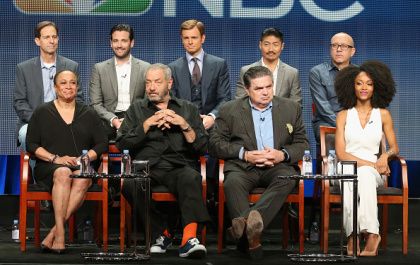
For more than three decades, one name has been synonymous with network procedural dominance: Dick Wolf. From courtroom showdowns to Chicago firehouses and New York interrogation rooms, Wolf’s franchises have shaped the very rhythm of primetime television. Now, NBC appears poised to double down once again.
Multiple industry insiders indicate that NBC is set to renew five Dick Wolf dramas, reaffirming its long-standing partnership with the prolific producer and securing the future of some of television’s most reliable ratings performers.
While official announcements are typically reserved for upfront presentations or press releases, all signs suggest that NBC is moving forward with renewals for:
-
Law & Order
-
Law & Order: Special Victims Unit
-
Law & Order: Organized Crime
-
Chicago Fire
-
Chicago P.D.
Here’s what this renewal wave means for NBC, for Dick Wolf’s television empire, and for the future of network drama.
A Television Empire That Refuses to Slow Down
Dick Wolf is not just a producer — he’s a brand. Since launching the original Law & Order in 1990, Wolf has built one of the most successful television universes in history. His shows are procedural, yes — but they’re also culturally responsive, emotionally grounded, and formulaically satisfying in a way audiences continue to crave.
In an era where streaming platforms chase cinematic prestige and experimental storytelling, Wolf’s dramas offer something different: dependable structure. A case. A conflict. A resolution. Week after week.
And viewers keep coming back.
The “Law & Order” Machine Keeps Rolling
The Law & Order franchise has long been a cornerstone of NBC’s lineup. Even after brief cancellations and cast changes, the brand remains remarkably resilient.
Law & Order (Flagship Revival)
The original series was revived in 2022 after a 12-year hiatus — a rare feat in television history. While the reboot initially faced skepticism, it stabilized in ratings and reaffirmed that audiences still have an appetite for the classic “ripped from the headlines” formula.
Law & Order: Special Victims Unit
The crown jewel of the franchise, SVU continues to thrive. Led by Mariska Hargitay, the series has become the longest-running primetime live-action drama in American television history.
Its endurance speaks not only to loyal fan support but to its ability to evolve with the times — tackling contemporary social issues while maintaining its core investigative structure.
Law & Order: Organized Crime
Though it has experienced creative shifts behind the scenes, Organized Crime remains a valuable extension of the universe. The return of Christopher Meloni as Elliot Stabler reignited fan enthusiasm, particularly among longtime SVU viewers.
Together, these three series form a programming block that NBC has strategically used to anchor Thursday nights — traditionally one of broadcast’s most competitive evenings.
Chicago Still Burns Bright
If New York is the legal battlefield, Chicago is Wolf’s action playground.
The “One Chicago” universe — though not all titles are included in this particular renewal wave — remains one of NBC’s strongest performing franchises.
Chicago Fire
As the original entry in the Chicago lineup, Chicago Fire blends high-stakes rescues with deeply personal story arcs. Its ensemble-driven storytelling has allowed it to survive cast exits and long seasons without losing emotional resonance.
Chicago P.D.
Often darker and more morally complex, Chicago P.D. pushes procedural storytelling into grittier territory. Its focus on internal conflict within law enforcement gives it a different tonal edge compared to its sister series.
The Wednesday night Chicago block continues to provide NBC with stable ratings in both linear viewership and delayed streaming metrics.
Why NBC Keeps Betting on Dick Wolf
In today’s fragmented media environment, consistency is gold.
Here’s why NBC’s investment in Wolf makes strategic sense:
1. Reliable Ratings
While streaming dominates headlines, broadcast networks still depend heavily on live viewership. Wolf’s shows routinely deliver steady numbers, especially among older demographics that advertisers value.
2. Syndication Power
Procedurals are built for reruns. Their episodic structure allows for endless syndication cycles — a financial advantage few serialized dramas can match.
3. Franchise Synergy
Crossovers remain a powerful marketing tool. When characters move between shows, it boosts ratings across the board. Wolf has mastered this strategy over decades.
4. Production Efficiency
Wolf’s production company operates with streamlined systems, shared crews, and interconnected writers’ rooms. That efficiency helps offset rising production costs across the industry.
The Cost Factor: Cast Salaries and Budget Pressures
Renewals don’t come without challenges.
Long-running series often face ballooning salary demands from veteran cast members. Negotiations with major stars — especially on legacy shows like SVU — can significantly impact budgets.
In recent years, NBC has also pushed for cost adjustments across its scripted slate, reflecting broader economic realities in the television business.
Still, even with rising costs, Wolf’s shows remain comparatively safer bets than launching entirely new dramas in an uncertain market.
What This Means for NBC’s Future
NBC has struggled at times to break out new scripted hits beyond the Wolf ecosystem. While comedies and limited series rotate in and out, Dick Wolf’s dramas remain the network’s foundation.
Renewing five of them sends a clear message:
NBC is choosing stability over experimentation — at least for now.
That strategy may not generate the social media buzz of a buzzy streaming thriller, but it delivers something arguably more valuable: long-term viability.
Fan Reaction: Predictable, But Welcome
Among fans, the expected renewals come as little surprise. Online communities devoted to Law & Order and the Chicago shows remain highly active.
There’s comfort in familiarity. For viewers who have followed these characters for years — even decades — renewals feel less like news and more like reassurance.
The Bigger Picture: Broadcast Drama Isn’t Dead
In a television landscape dominated by binge releases and algorithm-driven recommendations, Dick Wolf’s empire stands as proof that traditional network drama still works.
Appointment viewing still matters.
Procedural storytelling still resonates.
And audiences still crave weekly consistency.
As long as that remains true, NBC and Dick Wolf will likely continue their mutually beneficial partnership.
For now, the message is simple:
The Wolf pack isn’t going anywhere.