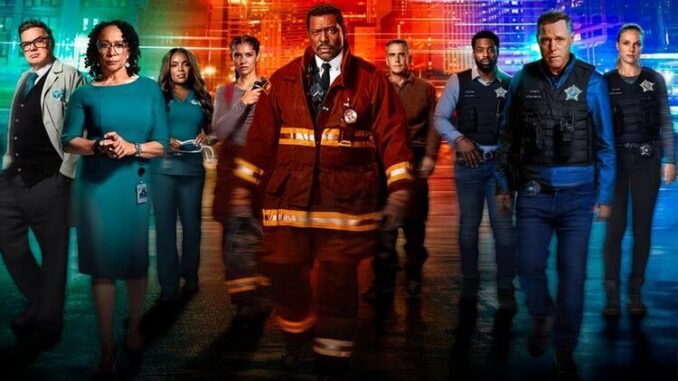
One Chicago delivers strong ratings for NBC as Chicago Fire continues to lead the franchise, even while fans anxiously await renewal news.
A Ratings Win That Feels Like a Cliffhanger
On paper, everything looks like a victory. Week after week, One Chicago continues to pull in solid numbers for NBC, proving that broadcast television still has room for long-running, character-driven dramas. At the heart of that success sits Chicago Fire, the emotional engine of the franchise and a TV show that refuses to fade quietly into the background.
And yet, despite those encouraging ratings, there’s one detail fans can’t stop thinking about: renewals are still not officially confirmed.
For viewers who have invested more than a decade into Firehouse 51 and its people, this strange limbo creates a mix of confidence and anxiety. How can a franchise performing this well still feel so uncertain? And what does this moment really mean for the future of Chicago Fire and the rest of the One Chicago universe?
The Bigger Picture: Why One Chicago Still Matters to NBC
In an era dominated by streaming platforms and shortened seasons, One Chicago remains one of NBC’s most reliable pillars. The franchise—anchored by Chicago Fire, alongside Chicago P.D. and Chicago Med—continues to offer something many networks struggle to maintain: consistency.
Unlike trend-driven shows that spike and vanish, One Chicago thrives on familiarity. Viewers know what night it airs. They know the tone. They know the emotional payoff. And for NBC, that predictability is gold.
What makes the ratings especially notable is that they aren’t driven by novelty. Chicago Fire is deep into its run, yet it still attracts a loyal audience that tunes in live, not just on-demand. That kind of viewer behavior is increasingly rare—and incredibly valuable.
Chicago Fire as the Franchise Anchor
While all three shows contribute, Chicago Fire remains the backbone of One Chicago. As the original series, it set the emotional template: found family, high-risk professions, and personal sacrifices that linger long after the sirens stop.
Over the years, the show has evolved. Early seasons leaned heavily into adrenaline and shock. Recent seasons, however, have shifted toward emotional weight—burnout, leadership struggles, and the cost of staying in a job that constantly asks for more.
That evolution is precisely why fans stay.
Chicago Fire isn’t just about rescues anymore. It’s about endurance.
A Season Defined by Emotional Stakes, Not Spectacle
This current season of Chicago Fire hasn’t relied on over-the-top disasters to keep viewers hooked. Instead, it has leaned into quieter, more personal storylines—an approach that resonates strongly with longtime fans.
Rather than asking “How big can we go?” the show seems to be asking, “How much can these characters carry?”
That shift matters. It signals confidence in the cast and the audience. It also suggests that the writers are thinking long-term, building arcs that could easily extend into future seasons—if renewals come through.
Characters Fans Can’t Let Go Of
One of the biggest reasons Chicago Fire continues to perform well is its cast. Over the years, the show has said goodbye to beloved faces, but it has also managed to rebuild without losing its emotional core.
Veteran characters now serve as emotional anchors, while newer additions bring tension and unpredictability. This balance keeps the storyline fresh without alienating fans who’ve been watching since the beginning.
Viewers don’t just watch Chicago Fire for the emergencies. They watch to see how these characters cope, clash, and support each other when the job takes its toll.
That emotional investment translates directly into ratings.
Themes That Continue to Resonate
Several themes stand out this season:
-
Leadership under pressure – Who is truly prepared to make impossible decisions?
-
Burnout and resilience – How long can someone keep running toward danger?
-
Found family – What happens when your coworkers are the only people who truly understand your life?
These aren’t flashy concepts, but they’re powerful. And they help explain why fans keep coming back even after so many seasons.
Chicago Fire doesn’t try to reinvent itself every year. It deepens instead.
Fan Reactions: Confidence Mixed With Unease
Online buzz around Chicago Fire has been fascinating. On one hand, many fans are confident that renewals are inevitable. The ratings, they argue, speak for themselves. NBC would be foolish to let such a dependable franchise slip away.
On the other hand, the silence has made some viewers uneasy.
Fan discussions are filled with questions rather than panic:
Why hasn’t the renewal been announced yet?
Is NBC renegotiating cast contracts?
Could this season be setting up potential exits, just in case?
Importantly, these are framed as theories—not confirmed information. But they reveal how deeply fans are paying attention, not just to what’s on screen, but to what’s happening behind the scenes.
Rumors, Timing, and Industry Reality
It’s worth remembering that renewal timing doesn’t always reflect performance. Industry factors—budget considerations, contract negotiations, scheduling strategy—often delay announcements, even for successful shows.
For a franchise as large as One Chicago, renewals are rarely simple. Each show involves a sizable cast, long-running contracts, and a production machine that needs careful coordination.
From that perspective, the delay may say less about doubt and more about logistics.
Still, until NBC makes it official, speculation will continue.
What Strong Ratings Could Mean for the Future
If ratings continue to hold, Chicago Fire is well-positioned for another season—and possibly beyond. Strong performance gives the network leverage, but it also gives the creative team room to plan.
A renewal would likely mean:
-
Continued focus on character-driven storytelling
-
Potential long-term arcs rather than rushed conclusions
-
Stability for the One Chicago crossover universe
Without confirmation, however, fans are left reading between the lines, analyzing each episode for signs of closure or continuation.
So far, the show feels more like it’s building than wrapping up—a detail that many viewers find reassuring.
The Emotional Contract Between Show and Audience
Long-running TV shows operate on an unspoken agreement. Fans give their time, loyalty, and emotional energy. In return, the show offers consistency, payoff, and respect for the characters’ journeys.
Chicago Fire has largely honored that contract. That’s why the renewal question feels so personal to viewers. It’s not just about numbers; it’s about whether the story they’ve invested in will be allowed to continue on its own terms.
NBC’s ratings success suggests the answer should be yes. But until it’s official, the waiting continues.
Final Thoughts: A Hit That Still Feels Unfinished
One Chicago coming up big in the ratings is undeniable. Chicago Fire remains a cornerstone of NBC’s lineup, proving that broadcast dramas can still thrive when they prioritize character, emotion, and consistency.
The lack of renewal news doesn’t erase that success—but it does add tension to an otherwise strong season. For fans, that tension mirrors the show itself: resilient, uncertain, and always pushing forward despite the unknown.
So now the question turns back to the audience.
Do you think Chicago Fire’s ratings make renewal inevitable, or is there more happening behind the scenes than fans realize?