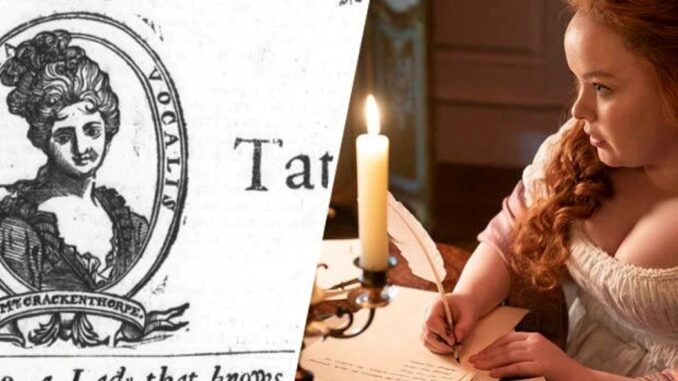
I will always believe in the power of gossip,” Penelope Bridgerton (Nicola Coughlan), née Featherington, aka Lady Whistledown, tells Queen Charlotte (Golda Rosheuvel) in part two of season four of Bridgerton. As the leading scribe of Regency London, Penelope has enjoyed a covert career under the pen name Lady Whistledown, documenting the goings-on of the ton as she watched from the sidelines. However, last season she was unmasked for everyone to see and miraculously was permitted to continue in her role even after she married Colin Bridgerton (Luke Newton).
But the pressure has taken a toll on Pen. The power of gossip as a whisper that travels on the wind — evolving as each new recipient hears it and growing into something that can ruin or exalt the subject — is one thing, but now that everyone knows Penelope is Whistledown and has adjusted their behavior around her accordingly, it is quite another.
Though her words have been weapons before, particularly as she wielded them against the Bridgertons, causing a rift with her future sister-in-law Eloise Bridgerton (Claudia Jessie), they never truly had the heft to take down such a powerful family. When it comes to a lower-class woman, like Virginia (Francesca Lara Gordon), the mistress of Hiscox (Cai Brigden), though, Penelope feels the weight of her quill. Upper-class men are a frequent topic of interest in “Lady Whistledown’s Society Papers” — which differs from the real-life scandal sheets of the time, which were usually anonymous, not unlike a blind item — and we’re often regaled with their escapades, but similar gossip about women can ruin their prospects and social standing.
“The codes of conduct that are expected of women are very different to the codes of conduct that are expected of men,” Bridgerton consultant and historian Hannah Greig told BBC’s History Extra podcast in 2024. “So, men have a much greater freedom in terms of their love lives, their relationships. Whereas women, if they become subject to scandalous reporting in the press, it can have a massive impact in terms of their standing and their status in society.”
“Since I have become known publicly, there has been a change. The power I hold over the ton is too great,” Penelope tells the queen. “I’m no longer a wallflower, an outsider. I am a Bridgerton. I’m privileged to visit the queen. Whistledown takes up a space which makes it impossible to deliver good, true, fair gossip.”
Good gossip
Good, fair gossip? Have you ever heard of such a thing? In post-2000s tabloid culture, when gossip magazines were the bane of the existence of many young female celebrities, such as Lindsay Lohan and Britney Spears, and paparazzi in pursuit of another royal, Princess Diana, drove her to her death, gossip has a stench to it. We’re taught to think of gossip as unbecoming and unkind, which it can be.
But it was also an apparatus of influence when women, up until recently, didn’t have much of it. Women such as Penelope, the pseudonymous Mrs. Crackenthorpe who wrote Female Tatler in the early 1700s, and Hollywood’s golden age gossip columnists Louella Parsons and Hedda Hopper delivered it through their words. With the widespread adoption of the printing press and an increase in literacy, particularly for women, storytelling and, yes, gossip migrated from oral traditions to written ones. It’s no coincidence that women writers such as Jane Austen and the Brontë sisters began writing about love, scandals, and familial intrigues, all topics ripe for gossip. Their narratives still capture our attention hundreds of years later, with Emerald Fennell’s adaptation of Emily Brontë’s Wuthering Heights dominating the box office and a new version of Austen’s Pride and Prejudice set to join Bridgerton on Netflix later this year. Now considered classics, these novels exemplify elevated gossip — what once was considered frivolous women’s business is now serious literature studied in school.
After all, Fennell told Vogue after a screening of Wuthering Heights that “gossip is an original power that women had. … It’s quiet power.”
Gossip girls
“The queen lives in a very gilded cage. Whistledown may be the only way she can travel to the outside world,” says the ever-wise Eloise about the queen’s stubborn refusal to let Penelope put down her pen. Whistledown’s chronicle of the queen’s subjects allows her a window into other people’s lives when her own life, consisting of hanging out with seen-but-not-heard ladies-in-waiting and various lapdogs, can sometimes be painfully monotonous. We see how much pleasure she gets from collapsing into fits of laughter with her best friend, Lady Agatha Danbury (Adjoa Andoh), over the Bridgertons’ melodramas.
But it’s perhaps the Featheringtons’ housekeeper Mrs. Varley (Lorraine Ashbourne) for whom gossip is her truest joy. Who among us can’t relate to Varley’s desire to gossip with her new colleagues at Penwood House, who weren’t having it, or Lady Portia Featherington’s (Polly Walker) disappointment when her new housekeeper doesn’t have any intel to offer on her neighbors? Though devolving into nastiness can leave the gossipers feeling dirty, a true exchange of information about people we know — or know of — can be invigorating.
In fact, evolutionary psychologist Robin Dunbar posits in his book Grooming, Gossip, and the Evolution of Language that gossip is the human version of other primates grooming one another, the most intimate of behaviors that signal group bonding.
Not only that, but gossip is a form of currency in its own way: It wasn’t bargaining for more money or calling Portia’s bluff by leaving to work for another family that demonstrated Varley’s value, but rather the camaraderie between the two that had been strengthened by gossip.
The true power of gossip: whisper networks
As we saw with the #MeToo movement, gossip is a form of protection too. How many people said Harvey Weinstein’s predatory behavior was an open secret in Hollywood and that actresses and other women lower on the totem pole would warn young hopefuls about meeting him alone before the New Yorker and New York Times exposés on him that led to #MeToo?
As it turns out, the rumor mill is not always a bad thing. “When people are interested in knowing if someone is a good person to interact with, if they can get information from gossiping — assuming the information is honest — that can be a very useful thing to have,” Dana Nau, told the University of Maryland about a 2024 study he co-authored with Stanford University on the evolution of gossip.
“If other people are going to be on their best behavior because they know that you gossip, then they’re more likely to cooperate with you on things,” Nau continued, further illustrating the power of gossip and shame. But if everyone’s on their best behavior, what will Lady Whistledown write about?! That’s a problem for next season’s scribe.
Ultimately, gossip is a tool of the masses. That’s why it’s no longer feasible for Penelope to remain as the author of “Lady Whistledown’s Society Papers” — while she still doesn’t have any real social, economic, or political power, which we saw her struggle with when she married Colin last season, as she says, she’s a Bridgerton now. Her writing about other high-society families exploits the very power gossip can hold for those below Penelope’s stature. And as we see at the end of this season, perhaps it’s time to welcome someone new.