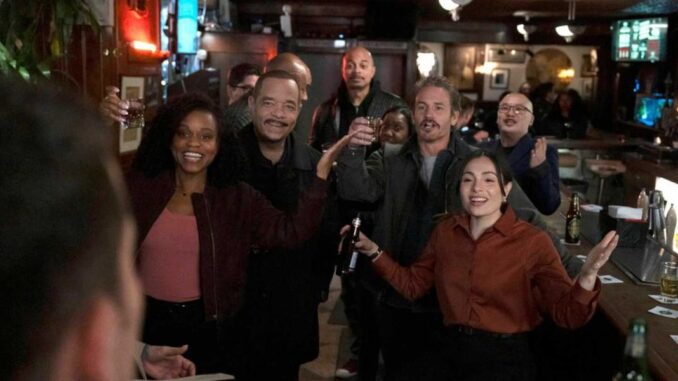
For more than two decades, Law & Order: Special Victims Unit has been one of television’s most enduring institutions. With its ripped-from-the-headlines storytelling, morally complex cases, and iconic performances—most notably Mariska Hargitay’s Captain Olivia Benson—the series has built a reputation for tackling society’s darkest crimes with gravity and empathy.
But in recent years, a strange narrative has begun to circulate among fans online, particularly on social media platforms like X, Reddit, and TikTok: Is SVU “cursed”?
Not in the supernatural sense—no haunted soundstages or eerie on-set legends—but in a far more modern, unsettling way. Fans have noticed a recurring pattern in which guest stars who appear on SVU later become embroiled in real-life scandals, sometimes years after their episodes aired. The coincidences have become so frequent that viewers are beginning to wonder whether it’s just bad luck… or something more unsettling.
A Pattern Fans Can’t Ignore
SVU has featured hundreds of guest actors since its 1999 debut. Many were rising stars at the time, while others were already well-known names. With such a massive pool of talent, statistically speaking, it’s inevitable that some would later face controversy.
Still, fans argue that SVU’s track record feels unusually heavy.
Online threads routinely list former guest stars who later faced allegations, arrests, career-ending scandals, or public downfalls. These discussions often go viral, with fans sharing screenshots, episode titles, and uncomfortable “before and after” timelines.
One Reddit user wrote, “At this point, when someone shows up as a guest star on SVU, I half-joke that we should check back on them in five years.” Another commented, “SVU isn’t predicting crimes—it’s accidentally casting people who later implode.”
The phrase “SVU curse” has become shorthand for this phenomenon, spreading quickly across fan communities.
The Nature of the Show Itself
Part of what fuels this perception is SVU’s subject matter. The show specializes in stories involving sexual assault, abuse of power, corruption, and hidden double lives. Guest stars are often cast as authority figures—teachers, politicians, celebrities, doctors—who turn out to be perpetrators.
When an actor later becomes involved in a real-world scandal, fans can’t help but draw eerie parallels between fiction and reality.
In hindsight, scenes feel darker. Dialogue becomes uncomfortable. Performances are reinterpreted through a new, troubling lens.
“It hits differently when you rewatch,” one fan posted on X. “You realize they once played a predator on SVU, and now they’re accused of something disturbing in real life. It’s chilling.”
Coincidence or Cognitive Bias?
Media psychologists and pop culture analysts are quick to caution against jumping to conclusions. With over 25 seasons and hundreds of guest appearances, SVU has simply existed long enough—and cast enough people—that overlap with scandal is statistically probable.
This phenomenon is known as confirmation bias: people remember the cases that support the narrative and forget the countless guest stars who went on to live scandal-free lives.
“There’s no curse,” one television historian explained in an interview. “SVU is a cultural giant. When something bad happens to a former guest star, people connect the dots retroactively.”
Still, even experts acknowledge why the theory resonates so strongly with fans.
The Power of Retrospective Storytelling
SVU episodes rarely fade quietly into obscurity. Thanks to streaming, reruns, and viral clips, old episodes are constantly rediscovered by new audiences.
When a scandal breaks involving a former guest star, clips from their SVU episode often resurface immediately, spreading rapidly online. Algorithms amplify the association, creating the illusion of a pattern stronger than it may actually be.
In a digital age driven by shock value and irony, the narrative practically writes itself.
“SVU predicted it” is more clickable than “Random coincidence involving a show with 500 guest actors.”
How the Cast and Crew View the Claims
Officially, neither NBC nor the SVU production team has ever addressed the so-called “curse.” Cast members have generally avoided engaging with speculation, focusing instead on the show’s mission and impact.
Mariska Hargitay, in past interviews, has emphasized that SVU’s goal has always been to give voice to survivors and raise awareness—not to sensationalize crime or scandal.
Behind the scenes, insiders reportedly view the “curse” talk as unfortunate but inevitable in the age of social media.
“You can’t control what happens in someone’s life years after they appear on your show,” one former crew member said anonymously. “It’s unfair to attach blame to a series that’s fundamentally about accountability.”
Fans Are Divided
Not all viewers buy into the curse theory. Many find it disrespectful, particularly toward survivors whose stories SVU aims to honor.
Others see it as dark humor—a coping mechanism for consuming such heavy subject matter year after year.
Some fans, however, admit that the pattern has made them uneasy.
“I love SVU,” one longtime viewer said. “But sometimes I do a quick Google search when I see a familiar guest star. Just in case.”
A Mirror to Society
Perhaps the most unsettling interpretation isn’t that SVU is cursed—but that it’s accurate.
The show has always portrayed how often abuse hides behind respectability. When real-life scandals echo those themes, it reinforces an uncomfortable truth: these stories are not rare.
SVU doesn’t create monsters. It reflects a society where power, secrecy, and accountability frequently collide.
In that sense, the so-called curse may simply be the cost of telling stories that are too close to reality.
The Legacy Remains Untouched
Despite online chatter, Law & Order: SVU remains a ratings powerhouse and cultural staple. Its longevity, influence, and emotional resonance are undeniable.
If anything, the “SVU curse” conversation underscores how deeply embedded the show is in the public consciousness. Fans don’t just watch it—they analyze it, mythologize it, and project meaning onto its long history.
Cursed or not, SVU continues to do what it has always done: force audiences to confront uncomfortable truths.
And perhaps that’s what truly unsettles people the most.