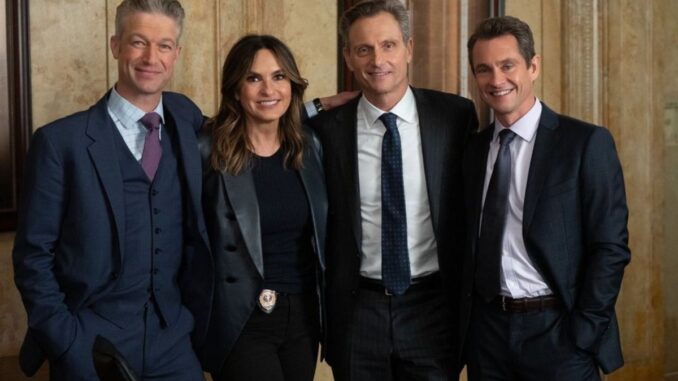
A Strong Start That Promised a Powerful Episode
For the first ten minutes of Law & Order: Special Victims Unit Season 27, Episode 13, it felt like viewers were about to witness one of the most gripping installments of the long-running procedural in recent memory.
The episode opens with a chilling sequence: a late-night ride share in Manhattan, an uneasy passenger, and a driver whose nervous glances in the rearview mirror hint that something isn’t right. The tension builds quickly—almost Hitchcockian in style. Within minutes, a call comes through to the Special Victims Unit, and the case begins.
The pacing in this opening act is classic SVU. It’s tight, suspenseful, and emotionally charged. Detective Olivia Benson, still the heart and moral compass of the series after all these years, immediately senses that the case may be larger than it first appears.
For longtime fans, the setup is exactly what they expect from the show: a disturbing crime, complex victims, and an investigative trail that slowly reveals uncomfortable truths about society.
But unfortunately, what begins as a promising and intense story gradually spirals into something far less coherent.
The Episode’s Core Mystery: A Case with Too Many Threads
At the center of Episode 13 is a case involving multiple victims connected to a ride-sharing app. Initially, detectives suspect a single predator targeting passengers late at night.
However, the narrative quickly introduces additional layers:
-
a data breach within the ride-sharing company
-
a suspicious driver network operating off the books
-
a tech startup linked to user tracking
-
a possible trafficking angle
-
and an unexpected political scandal
In theory, these elements could have created a sophisticated, multi-layered story. SVU has successfully handled complicated plots before.
But here, the episode seems to struggle under the weight of its own ideas.
Instead of weaving these threads into a cohesive narrative, the script jumps abruptly between them. Just as viewers start to follow one lead, the story pivots to something entirely different.
The result is an investigation that feels scattered rather than strategic.
Olivia Benson Still Anchors the Show
Despite the narrative confusion, one element remains reliably strong: the performance of Olivia Benson, portrayed by Mariska Hargitay.
After more than two decades leading SVU, Hargitay continues to deliver the emotional gravity that defines the series. In Episode 13, Benson’s scenes with survivors once again highlight her empathy and determination.
One particularly memorable moment occurs midway through the episode when Benson interviews a young victim who initially refuses to speak. Instead of pushing aggressively for answers, Benson quietly sits beside her, allowing silence to do the work.
It’s a reminder of why the character has remained such a powerful figure on television: she listens.
Even when the plot loses direction, Benson provides a steady emotional center.
The Supporting Cast Tries to Keep Up
The rest of the SVU squad does its best to navigate the increasingly complicated storyline.
Detective Fin Tutuola, played by Ice‑T, delivers several sharp lines that cut through the chaos. Fin’s skepticism toward the tech company involved in the case adds a grounded perspective to the investigation.
Meanwhile, Assistant District Attorney Carisi—portrayed by Peter Scanavino—faces a courtroom dilemma when key evidence suddenly becomes questionable.
These performances remain strong individually. But because the script frequently shifts focus, characters rarely have enough time to fully explore the stakes of the situation.
Scenes feel truncated, as if entire conversations were left on the editing room floor.
A Mid-Episode Twist That Changes Everything… and Not for the Better
Around the midpoint of the episode, a major twist is revealed.
The suspected serial predator turns out not to be acting alone—or possibly not even responsible for the original crime. Instead, investigators uncover evidence suggesting the ride-share platform’s internal data algorithm may have inadvertently exposed vulnerable users.
It’s an intriguing concept: technology unintentionally facilitating crime.
But the episode doesn’t spend enough time explaining how the system works or why it matters.
Instead, the narrative leaps quickly from discovery to accusation to confrontation. By the time Benson and the team confront the tech company’s executives, the audience is still trying to understand the mechanics of the problem.
This creates a strange viewing experience where the stakes feel high but the logic feels unclear.
Editing and Pacing Become the Episode’s Biggest Problems
One of the biggest issues with Episode 13 isn’t the premise—it’s the pacing.
Scenes often end just as they start to become interesting. Other moments linger far longer than necessary, particularly during exposition-heavy conversations about corporate policy and digital privacy.
In earlier seasons of SVU, complex cases were typically balanced with a clear investigative structure: interview witnesses, gather evidence, identify suspects, build the case.
Episode 13 abandons that rhythm.
Instead, it jumps unpredictably between interrogation rooms, tech offices, courtroom debates, and street investigations.
The result feels less like a focused investigation and more like a collection of loosely connected scenes.
The Final Act Feels Rushed
By the time the episode reaches its final act, viewers might expect the scattered threads to finally come together.
Instead, the conclusion arrives surprisingly quickly.
A last-minute confession from a minor character suddenly resolves several major questions. Meanwhile, the broader corporate scandal introduced earlier in the episode is left largely unresolved.
The final courtroom scene—usually one of SVU’s strongest storytelling tools—feels particularly underdeveloped.
Carisi presents his argument, the judge makes a ruling, and the episode abruptly cuts to Benson reflecting on the case.
It’s an ending that feels less like closure and more like an unfinished conversation.
A Rare Misstep for a Legendary Series
There’s no denying the cultural impact of Law & Order: Special Victims Unit.
As one of the longest-running primetime dramas in television history, the show has consistently tackled difficult and complex subjects with sensitivity.
Even after more than 25 seasons, SVU continues to produce powerful episodes that resonate with audiences.
That’s what makes Episode 13 somewhat disappointing.
The ingredients for a compelling story were all present:
-
a timely theme about digital privacy
-
a strong opening sequence
-
talented actors
-
and emotionally resonant subject matter
But somewhere between the first act and the final scene, the narrative loses its way.
Still Worth Watching? Absolutely
Despite its flaws, Episode 13 isn’t without merit.
The performances remain strong, particularly from Hargitay. The opening sequence is genuinely suspenseful. And the episode’s attempt to explore the intersection of technology and crime is undeniably relevant.
For devoted SVU fans, it’s still worth watching.
Even the show’s weaker installments often contain moments that remind viewers why the series has endured for so long.
And sometimes, a confusing episode can lead to stronger storytelling in the weeks that follow.
Final Verdict
SVU Season 27 Episode 13 starts with the promise of a gripping, socially relevant mystery.
But as the episode unfolds, its ambitious ideas begin to compete with one another rather than complement each other.
What begins as a sharp and suspenseful investigation gradually transforms into a story that feels rushed, fragmented, and occasionally difficult to follow.
Still, thanks to committed performances and the enduring presence of Olivia Benson, the episode remains watchable—even if it never quite reaches the potential hinted at in its impressive opening.
Sometimes even television’s most reliable series can lose its narrative footing.
The good news?
If SVU’s history is any indication, the next case might be right back on track.