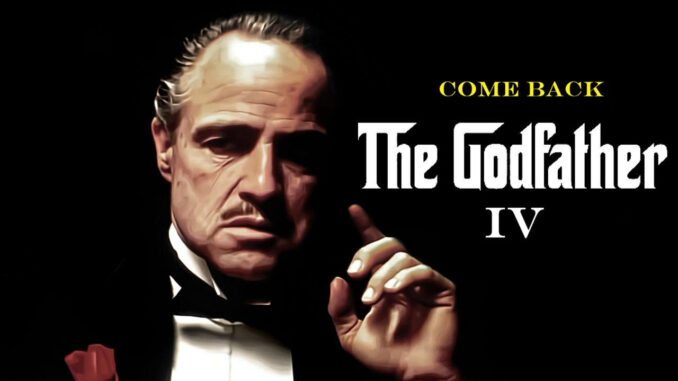
There are endings that conclude a story—and then there are endings that change how the entire story is understood.
The final moments of The Godfather belong to the latter.
There is no explosion.
No dramatic confrontation.
No final line meant to echo.
Instead, there is a door.
By the time the film reaches its closing sequence, Michael Corleone has already completed his transformation. He has consolidated power, eliminated threats, and secured his position as the new head of the Corleone family. On the surface, everything has been achieved.
But the film does not end with power.
It ends with distance.
Kay, played by Diane Keaton, confronts Michael with a question that feels simple but carries enormous weight. She asks him directly about his involvement in violence—about who he has become.
For a brief moment, Michael denies it.
And then, unexpectedly, he reassures her. He promises that it will not happen again. He offers a version of truth that feels designed not to convince the audience, but to preserve what little remains of his personal life.
Kay chooses to believe him. 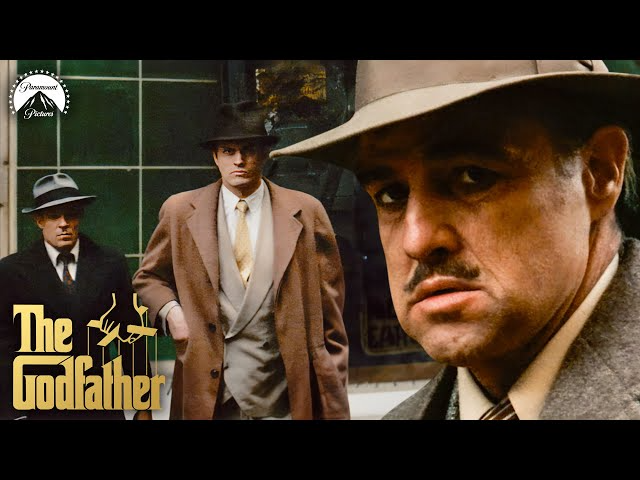
Or perhaps, she chooses not to challenge him further.
What follows is one of the most chilling visual moments in cinema.
As Kay watches from a distance, men enter the room. They greet Michael not as a husband, not as a son—but as Don Corleone. The title is no longer symbolic. It is real, fully realized, and publicly acknowledged.
Michael does not look at Kay.
He does not explain.
He does not correct anything.
The door closes.
Slowly. Deliberately. Without hesitation.
And just like that, the separation is complete.
What makes this moment so powerful is its restraint. The film does not need to state what has been lost. It shows it. The closing door becomes more than a physical action—it becomes a boundary between two worlds.
On one side: Kay, representing the life Michael once had, or could have had.
On the other: Michael himself, fully consumed by the role he has chosen.
There is no return from that moment.
No redemption is offered.
No balance is restored.
Only silence.
Over the years, this scene has been studied, referenced, and recreated, but its impact remains unchanged. It captures something rare: the exact moment a character loses the last connection to who they used to be.
Michael does not just gain power in this scene.
He loses everything else.
And that is why the ending of The Godfather continues to resonate—not as a conclusion, but as a realization.
That sometimes, the most important moment in a story is not when someone rises…
But when they close the door behind them.