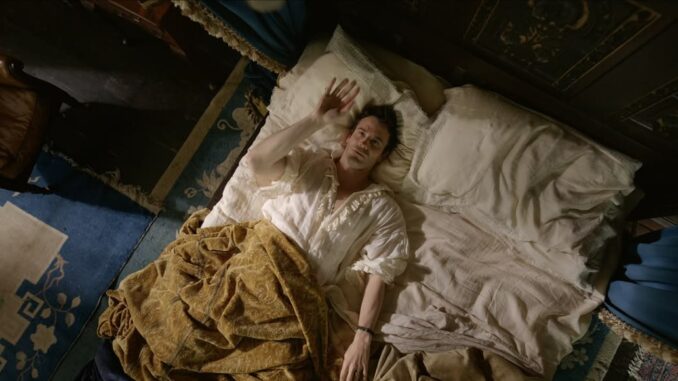
Bridgerton Season 4, Episode 6, “The Passing Winter,” explores whether Benedict, Sophie, and the characters in the ton can change in a society that doesn’t nurture that. This episode, written by Annabelle Hood and directed by Amy McIntrye, gets in the weeds of the weight of Benedict and Sophie’s relationship. The most experienced to cut through it is Anthony Bridgerton, as Jonathan Bailey returns with Simone Ashley’s Viscountess Kate Bridgerton. Anthony’s presence and the episode’s devastating turn make it obvious how critical the Bridgerton family is to the show.
Reality also pierces Benedict and Sophie when a pregnancy scare looms over the couple. The masquerade ball’s fantasy feels so far away from them now. That distance works in the convincing time that has passed since then. Although these four episodes are sure to be binge-watched like the first part, the narrative supports its in-story longevity. Before, it does so through flashbacks, montages, and whirling editing. Now, it’s the careful consideration of a calendar. With that, “The Passing Winter” presents another hurdle for Benedict and Sophie, as well as one of Bridgerton’s most breathtaking moments.
Time Slows Down for Sophie
Sophie carries the all-consuming burden that she may be pregnant. Exasperated by additional stressors, Sophie fears that she’s repeating a cycle. Bridgerton captures that anxiety in those increasingly forboding scenes – the tilted camera, blowing the one source of light out – of Sophie ticking off days in her calendar. Those technical aspects support Yerin Ha’s internal – Sophie bottles everything up – performance. It also creates a painful juxtaposition. After all, Sophie tells Benedict that gentlemen, like him, have “endless free time,” while the women in their lives can be stuck in it.
Therefore, Bridgerton makes it anything other than frustrating for Sophie to send the letter to Penwood House. Sophie will do anything to maintain a position that will give her a livelihood to protect herself and a potential child. So, the pregnancy scare is exactly that; it’s enough of a reminder of the harsher aspects of the reality in which she exists. Sophie’s backstory in Bridgerton Season 4, Episode 2, “Time Transfixed,” makes her fear of abandonment and rejection, as well as her sense of responsibility from a young age, more than conceivable. They’re facts, foundational parts of this character.
They are on Sophie’s sleeve in that time-stopping moment when Sophie and Posy come face to face in Bridgerton House’s drawing room. That scene is a great spin on the book’s counterpart; it doubles as a vehicle for Isabella Wei’s comedic timing. Fantastically, “The Passing Winter” also makes baby Edmund into a symbolic elephant in the room for Sophie and Francesca – another example of this season’s streamlined nature. Therefore, the show makes it so there is no doubt why Sophie has one foot back at Penwood House. The reminders of how real this is getting are everywhere.
Is Benedict Bridgerton Capable?
If Bridgerton Season 4, Episode 5, “Yes or No,” helps Benedict understand his offer’s nuances, “The Passing Winter” makes him contend with the societal fact that a life with Sophie is anything but simple. That reality doesn’t become more plainly evident until Anthony holds his brother’s feet to the fire. That truth shines through when Benedict’s words are certain of his feelings for Sophie, and his voice is confident in his plan, but his expression falters when considering the wide-ranging fallout of both.
It doesn’t help that Anthony compares his relationship with Sienna to what Benedict and Sophie have. Nevertheless, Anthony’s rationality contending with Benedict’s sentimentality results in one of the episode’s – and Bridgerton’s – best scenes. Anthony returns with a renewed perspective, having become a father (There’s much to love about that brief scene with Anthony, Kate, and Edmund!). The essence of fatherhood is also present in the scene as Edmund’s portrait hangs between them.
Anthony’s efforts to protect the family and its legacy are a reminder of how embedded the Bridgertons are in society. So, being with Sophie changes Benedict’s relationship with his tight-knit family and preemptively denies that for any children they have. That’s a significant change to conceptualize; it’s far more specific than abandoning “society.
All the while, Benedict’s capabilities to feel, think, and love are tested to a frustrating effect for him, twisting around his deep-set insecurities. Bridgerton visualizes that with Benedict on the outside of that drawing room scene with baby Edmund. The show, once again, pours salt in the wound of Benedict being the spare that’s no longer necessary in the line of succession. Simultaneously, “The Passing Winter” engages with how a child can bring a family together, but a child, born to a gentleman and a maid, can tear it apart.
Power and Influence in the Ton
Whether Lady Whistledown will evolve or rest loses most of the momentum gained in “Yes or No.” Instead of using her privilege to comment on or push society further, Penelope puts her pen down. However, Penelope looking at herself in the mirror to see the younger version of herself is an incredible touch. It reflects Nicola Coughlan’s choices to show Penelope’s growth in her confidence and physicality. Additionally, it emphasizes Penelope’s decision as a personal one as much as a considerate and professional one.
The latter is further appreciated and complicated by Cressida’s return (Every detail couldn’t be more in character, from the obscene amount of pink to the wild invitation) to the ton. Cressida benefits from Penelope not writing about her. However, earlier, Cressida echoes Virginia’s comments that Penelope can influence gossip and, therefore, society. So, it’s confounding yet understandable that Penelope doesn’t explore that before penning her last issue.
Penelope’s monologue about Whistledown puncturing the cage is constructive for Charlotte and Agatha. That final scene between them – there aren’t but four words exchanged, and it’s still a moment of emotional release. Again, Bridgerton keeps their shared history present with their portrait. Golda Rosheuvel and Adjoa Andoh are simply brilliant at portraying how much these two characters love each other and value their friendship.
Meanwhile, Alice makes strides as a lady-in-waiting with Will by her side. (They’re one of the best couples on this show!) Her choice not to sell out Benedict and Sophie speaks volumes. It’s also a soaring vote of confidence that Charlotte chooses to go along with Alice’s plan for Cressida’s ball. Unlike Penelope putting down her quill as Whistledown, which feels too easy, this season earns Alice sitting back and saying, “I’ve got my own pair of shoes now.”
Eloise, Francesca, and Personal Changes
It’s enjoyable that Penelope’s new approach with Charlotte stems from Eloise, who is becoming more curious and less definitive about society’s conventions. It’s a mark of improvement that Eloise wants to know about Cressida’s marriage. Eloise also equates Charlotte’s cage – and, therefore, her loneliness – to her own, which takes self-awareness. It’s also intentional that the camera moves to Eloise as Kate discusses young women being able to change.
Additionally, Eloise’s attempt to resolve things with Hyacinth proves why Benedict can’t recognize Sophie in the Lady in Silver. Hyacinth believes herself invisible as a maid, and Eloise replies, “That, or invisible to someone who cares only about rank.” Benedict doesn’t only care about status; it’s an implicit bias that Benedict is still working through, which is far more realistic than Benedict having no flaws.
Meanwhile, Francesca’s changes exist on opposite ends of the spectrum. There’s the high of finally becoming friends with Michaela and the low of losing John. Finding the middle ground between those two points through a puzzle where all three characters are necessary to complete it is beautiful work, truly.
John’s death is devastating. The show has been signaling it for episodes (The headaches!). Over the last season and a half, Bridgerton has made it so easy to fall in love with John, as well as his love story with Francesca. “The Passing Winter” elevates that with their scene outside Cressida’s ball that feels like the bittersweet bookend to their meet-cute. The chemistry between Hannah Dodd and Victor Alli is so excellent. The love between their characters is often unspoken, in the silence, but not then. Dodd, in the final scene, is absolutely breathtaking. She makes Francesca’s scream ring in your ears.
Benophie and Being Loved & Known
The conservatory scenes are a beautiful addition. They create a natural symmetry to the episode’s structure. They also have a tonal distinction from the freedom of Benedict and Sophie’s time at My Cottage. For instance, there’s a fantastical element to their scene there at night, where it’s a whole world of their own, free of societal rules. The set dressing’s warmth invites an intimacy that supports the dialogue’s depth as the leads get to know each other better. To use a modern phrase for a Regency era character, it feels like a safe space for Benedict to “come out” to Sophie. That scene plays out really beautifully, with Benedict having zero shame and Sophie accepting him.
That first conservatory scene also plays as a response to Will’s comment in “Yes or No.” In that, Benedict exercises his own emotionality and considers Sophie’s in their potential life together. That chance really opens up when him when Sophie does the same and shares that she’s a nobleman’s illegitimate daughter. In execution on the page and delivery from Yerin Ha, Sophie’s saying, “My very existence in this world is a shameful secret,” cuts through society’s cruelty and the pain Sophie lives with every day.
Where the first one belongs to Ha, this second scene is Luke Thompson’s. The light of day opens up the space to a colder tone. The truth that love isn’t enough to get them over society’s walls is unavoidable. He delivers this devastating performance where the emotion bubbles up in Benedict while he tries to ground himself and stamp it down. Benedict is so desperate to make this work, but it’s written all over his face that it’s all far more complicated than he initially imagined. Any resolution is too close to that of a mistress, and, understandably, that can’t be a reality for Sophie.
So, again, Sophie gathers the courage to walk away from the person she loves. Despite her heart breaking, she does that so Benedict doesn’t lose his family. In the same breath, Sophie is also losing the family she has come to love by working at Bridgerton House. Ha packs all of that into Sophie’s reaction that only comes in the privacy of her room. With only two episodes left, “The Passing Winter” leaves the season’s leads in a place that feels impossible to navigate because society has made it so. There’s no denying that Bridgerton Season 4 Part 1 refuses to shy away from reality. And what’s more real and sobering than losing the one you love because of forces outside of your control?