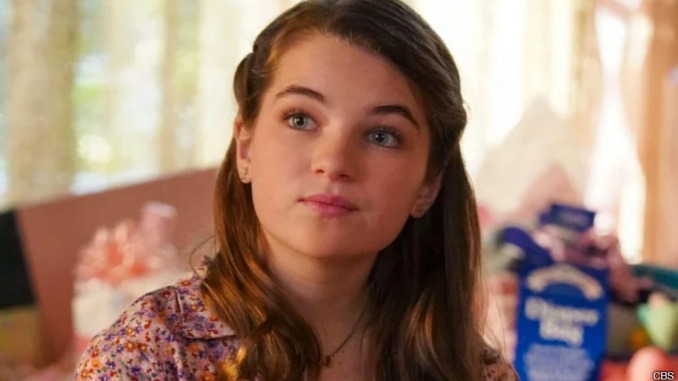
Raegan Revord played Missy Cooper—Sheldon’s sharp-witted and rebellious sister—for seven seasons on Young Sheldon. Yet, despite her fiery personality, one thing about Missy remained oddly static: her hair. Sure, there were rare exceptions—she occasionally wore a ponytail, and in one episode, she even dyed her hair blonde. But for the most part, her hairstyle never changed, which felt a bit inconsistent for a character known for pushing boundaries.
Behind the scenes, Revord repeatedly asked for a haircut, only to be denied for four years straight. It wasn’t until Season 6—after she experienced a traumatic real-life car crash—that she was finally allowed to change her look. Following much debate, the showrunners granted her request.
In a 2023 interview with Entertainment Tonight, Revord recalled the moment:
“They called me over and said, ‘Hey, we have some news for you.’ Then my hair person walked in, and I was like, ‘No, no, no, no, no. This is not happening!’ But they told me, ‘You get to cut your hair.’ Now I have short hair, and I love it so much. I got Van Leeuwen [ice cream] and a haircut—what more can you ask for?”
Missy’s shorter hairstyle made its debut in Young Sheldon Season 6, Episode 18 (Little Green Men and a Fella’s Marriage Proposal). However, even then, the change was relatively subtle—nowhere near as drastic as Penny’s (Kaley Cuoco) pixie cut in The Big Bang Theory Season 8, which caused quite a stir among fans.
The Big Bang Theory Rule That Almost Never Breaks
The reason Missy’s hair stayed the same for so long? Big Bang Theory creator Chuck Lorre has a strict rule against major cast members making drastic hairstyle changes. Penny’s pixie cut was a rare exception, and it reportedly caused some behind-the-scenes tension.
In The Big Bang Theory: The Definitive, Inside Story of the Epic Hit Series (2022), Lorre explained why he was so adamant about keeping characters’ looks consistent:
“The audience had become infatuated with the character—not just their behavior, flaws, and strengths, but also their appearance. They became iconic, and disregarding that audience attachment was a mistake. I witnessed it firsthand. It would’ve been the same if Johnny [Galecki] had shaved his head at the wrap party. We’re all in this together!”
How Hair Can Be a Powerful Storytelling Device
Most sitcoms allow characters to change their hairstyles as a reflection of personal growth. Scrubs did this masterfully with Elliot (Sarah Chalke), whose hair evolved alongside her confidence. In the first two seasons, she sported a safe, conventional look, reflecting her insecurity and struggle to establish herself. As she became more self-assured, her haircuts grew bolder. By the later seasons, her style was more refined, mirroring her transformation into a confident doctor.
Similarly, How I Met Your Mother used hairstyles to signal different eras—Lily’s (Alyson Hannigan) ever-changing hair helped define the early seasons, while Robin’s (Cobie Smulders) remained mostly the same, emphasizing her consistency as a character.
Outside of sitcoms, dramas like Mad Men and Succession used hair as a storytelling device. Peggy Olson’s (Elisabeth Moss) evolving hairstyle mirrored her rise in the advertising world, while Shiv Roy’s (Sarah Snook) sharp bob in Season 2 symbolized her growing power and control.
By rigidly adhering to The Big Bang Theory’s visual rules, Young Sheldon missed an opportunity to add more depth to Missy’s character. While keeping a consistent look works for some characters, a rebellious teenager like Missy would have benefited from a more dynamic evolution. Letting her break The Big Bang Theory’s hair rule could have made her even more compelling.