Dearest gentle reader,
A new season of our beloved Bridgerton is upon us and like so many of you, I have inhaled it. Except, I got to do so a little earlier than most as a treat from Netflix in preparation for my very prestigious audience on a December night with Golda Rosheuvel (Queen Charlotte) and Adjoa Andoh (Lady Danbury).
Sitting under the glowing heat of a ring lamp with a fully made-up face, I asked them questions about loneliness and finding yourself. It was a London morning for them on a very long day, and they were as gracious, generous and kind as you could hope. Every bit the regal, wise and straight-talking women, they’ve given voice to for so many years now.
The hardest part of the luxury that is getting to see one of the biggest TV shows of modern times, before anyone else (and I’m aware this is a tiny violin) is that you’re not allowed to talk about it. With anybody. At all. For fear that if you do, the battalion of highly trained Netflix guards, otherwise known as the PR and publicity departments will descend on you with the ferocity of valiant knights willing to do anything to protect their kingdom.
So, I stay quiet.
Hold the moments that make me swoon, laugh, cry and wonder at the inability of a certain Bridgerton brother, who is fondly my favourite, to put two and two together close to my chest. And for the most part, it’s not a struggle.
Sure, I’d love to gush to my friends about the seductive thrill of a masquerade ball, or tell them just how spectacular Yerin Ha is as this season’s diamond, how deftly she navigates a new frontier; the impossible to ignore chasm of classism that runs right down the middle of Mayfair, that until now the show has sidestepped.
But the hardest moments for me to keep under my hat are much quieter. More subtle. They’re the moments that have me scrambling to hit pause to make sure I’m seeing what I think I am.
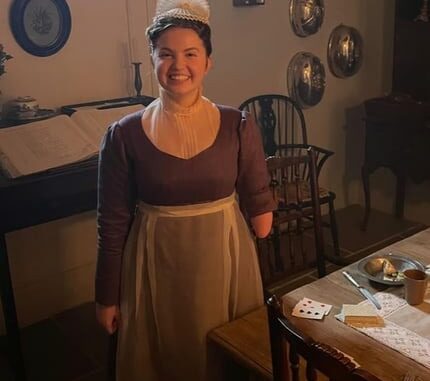
The couple, played by Alice Devlin and Jude Powell, communicating fluidly and fluently in sign language during a ton gossip session while promenading. Or the character of Hazel, brought to life by Gracie McGonigall, a household maid and firm friend of this year’s leading lady Sophie Baek, missing an arm (Gracie was born with a congenital limb difference).
Those moments make me want to shout from the rooftops (as long as there’s a lift, of course).
Why? Because this no-fuss ‘of course, there are disabled people in our show, why wouldn’t there be’ approach to representation, typical of the Shondaland empire, is all I’ve ever wanted.
Since I was a little girl, desperately searching for anyone who looked like me in the books I read, media I loved or toys I played with. I’ve written thousands of words over the years about how coming up empty-handed in that search, or even more confusingly with actors who slip into bodies until a director calls ‘Cut’ makes a person feel.
The crater it leaves behind, tunnelling from your heart to just under your ribcage, where you breathe. The questions it forces you to ask yourself; where am I? Why am I not here? Where do I belong?
Do I deserve to exist?
Those questions and answering them with incontrovertible proof for myself and for others, is one of the many reasons why I became an actor. Why I am so proud to have started conversations, pushed the envelope and made people think. After all, I am the first person in Australia with a disability to do a sex scene on television thanks to SBS Digital Originals series Latecomers, and I don’t plan on going anywhere. Not as an actor or a writer, or producer. Nor do I plan on necessarily making all of my roles that jaw-dropping. My performance? Yes. My existence on screen? Absolutely not.
Instead, I plan to blaze a trail. To tell stories. Some that are absolutely centred on a disabled character’s experience – I haven’t forgotten about that animated princess, even if I have to do it myself and have BIG plans for the inter-abled (one person is disabled while the other is able-bodied) romantic comedy currently sitting on my laptop with a work-in-progress script.
And some that aren’t. Because I have more to say than just this one thing. But, no matter what, those characters will still be there as will other forms of representation. That’s just what the world looks like in 2026 and to do anything else feels deliberately obtuse.
There seems to be a common misconception among creatives and audiences alike that in order to justify including disability or disabled actors in the world you’re making, you must be doing something edgy or distinctively inspiring.
Making people feel uncomfortable or confronted. But that’s not true. And neither is the idea that a disabled actor can only bring characters to life for whom their disability is everything about them. It’s not everything about us, so why should it be that way on screen?
We can be people with widely different goals, arcs, dreams and ideas of what makes a good life. That variety deserves to be seen and celebrated but also just normalised. Because, in spite of what my brain tries to tell me thanks to years of conditioning, there is nothing more normal than disabled people getting to live our lives as we want and existing just like everyone else.
Bridgerton knows that.
And if a show set in regency-era England where the reality of disabled life was grim or over before it even really started, then the rest of the industry has absolutely no excuse.