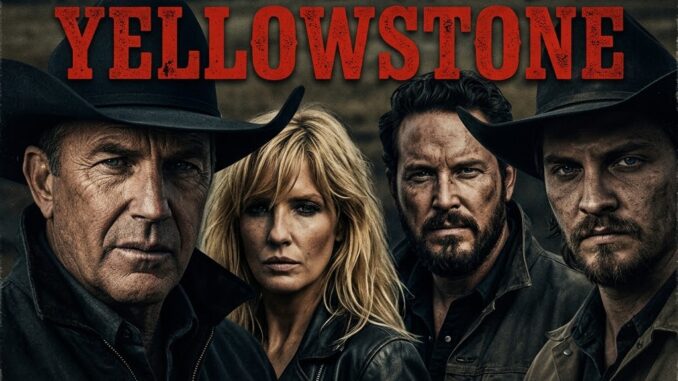
The Cowboy Blueprint: How Taylor Sheridan’s ‘Walker, Texas Ranger’ Guest Spot Paved the Way for ‘Yellowstone’
Long before the world knew the name John Dutton or felt the ruthless sting of a “Yellowstone” betrayal, a young, gritty actor named Taylor Sheridan was already cutting his teeth on the rugged plains of Texas. But he wasn’t writing the scripts—he was dodging roundhouse kicks.
If you look closely at the late ’90s television landscape, you’ll find a fascinating breadcrumb trail leading straight from the campy, high-kicking justice of Walker, Texas Ranger to the Shakespearean drama of the Dutton ranch. It turns out, Taylor Sheridan’s appearance on the Chuck Norris classic wasn’t just a paycheck; it was a masterclass in the Western ethos that would eventually redefine modern television.
The Cameo That Started It All
In 1995, Taylor Sheridan appeared in the Walker, Texas Ranger episode titled “The Guardians.” Playing the character of a young, somewhat reckless individual, Sheridan was essentially an extra in the orbit of Chuck Norris’s legendary Cordell Walker.
At the time, Sheridan was just another face in Hollywood trying to make his mark. However, even in a minor role, he was absorbing the atmosphere of the “Neo-Western.” He wasn’t just acting; he was observing how a show could center itself around a moral code, a specific geography, and a sense of rugged individualism.
Why Texas Was the Perfect Training Ground
Texas isn’t just a state; it’s a character. Sheridan has often spoken about his deep roots in the Lone Star State, and his time on the Walker set reinforced the idea that the setting dictates the stakes.
The Mythology of the Lawman
Chuck Norris’s Walker was a modern-day knight in a Stetson. He represented an unwavering moral compass. When Sheridan transitioned into writing and directing, he took that “Lawman” archetype and flipped it on its head. In Yellowstone, the law is often whatever the Duttons say it is.
The Aesthetic of the West
Walker, Texas Ranger utilized the sprawling landscapes of Texas to tell stories of good versus evil. Sheridan saw the power of the horizon. He realized that if you put a camera in the middle of nowhere, the isolation becomes a pressure cooker for drama.
Breaking Down the ‘Yellowstone’ DNA in 90s Television
It’s easy to dismiss 90s procedural shows as simplistic, but for a creator like Sheridan, they were the “primordial soup” of his future hits.
The Importance of the “Man’s Man” Archetype
Before we had the brooding Rip Wheeler, we had the stoic Cordell Walker. Sheridan’s acting stint allowed him to see how audiences connected with characters who spoke softly but carried a big stick (or a very heavy boot). This archetype became the backbone of every male lead in the Sheridan-verse.
Action as a Narrative Tool
In Walker, the action was the point. In Yellowstone, the violence is a consequence. Sheridan learned that while people love a good fight, they stay for the reason behind the fight. His time on a high-action set taught him the logistics of the Western “brawl,” which he later perfected with much higher emotional stakes.
The Transition from Actor to Architect
Why does a guest spot on a Chuck Norris show matter? Because Sheridan eventually grew frustrated with being “just an actor.” He realized he was playing characters in stories that didn’t have enough depth.
“I spent years telling other people’s stories before I realized I had my own to tell,” Sheridan has reflected in various interviews.
His time on Walker gave him a front-row seat to the industry’s limitations. He saw the tropes, the clichés, and the predictable endings. When he finally sat down to write Wind River, Sicario, and eventually Yellowstone, he wasn’t just creating something new—he was actively deconstructing the Western world he had lived in as a young actor.
The Parallel Between Cordell Walker and John Dutton
At first glance, a Texas Ranger and a corrupt Montana rancher have nothing in common. But look closer.
-
Land is Everything: Both shows operate on the idea that land is the ultimate prize.
-
Family Legacy: Walker’s partner and friends were his family; the Duttons are a literal (and often lethal) family unit.
-
The Moral Gray Area: While Walker was black and white, Sheridan’s time on that show clearly made him want to explore the “gray.” What happens when the hero isn’t a Ranger, but a man trying to keep his land by any means necessary?
How ‘Walker’ Influenced Sheridan’s Directorial Style
Sheridan is known for his “cinematic” TV. He treats every episode of Yellowstone like a feature film. Walker, Texas Ranger was a product of its time—episodic and shot for 4:3 television screens. By being part of that production, Sheridan saw what not to do. He traded the flat lighting of the 90s for the golden-hour sweeps of the Bitterroot Valley.
The “Sheridan-Verse” Roots: More Than Just a Cameo
Every great creator has an origin story. For Sheridan, it was the dusty trails of Texas television. He learned the rhythm of the Western dialogue—the sparse, punchy sentences that feel like a gunshot.
The Cultural Impact of the Modern Cowboy
Through his early roles, Sheridan recognized a hunger in the American public for stories about the frontier. He realized that the “Cowboy” wasn’t dead; he just needed a makeover. He took the badge from Walker and gave it to the complex characters in 1883 and 1923.
The Lessons of High-Stakes Storytelling
One thing Walker, Texas Ranger did exceptionally well was create a sense of urgency. Sheridan took that urgency and injected it with steroids. In the Walker era, the stakes were often “catch the bad guy.” In the Yellowstone era, the stakes are “survive the end of a way of life.”
A Full Circle Moment
It’s poetic, isn’t it? Taylor Sheridan started his career in the shadow of a Texas legend and ended up becoming a legend of the West himself. He didn’t just guest star on a Western; he studied it, dismantled it, and rebuilt it into a multi-billion dollar empire.
Conclusion: The Legacy of the Lone Star
Taylor Sheridan’s appearance on Walker, Texas Ranger was far more than a footnote in his IMDB profile. It was the spark. It gave him the grit, the geographical obsession, and the foundational understanding of the Western genre required to build Yellowstone. He moved from being a participant in the myth of the West to being its primary storyteller. Without that young actor in Texas, we might never have seen the rise of the Dutton family.