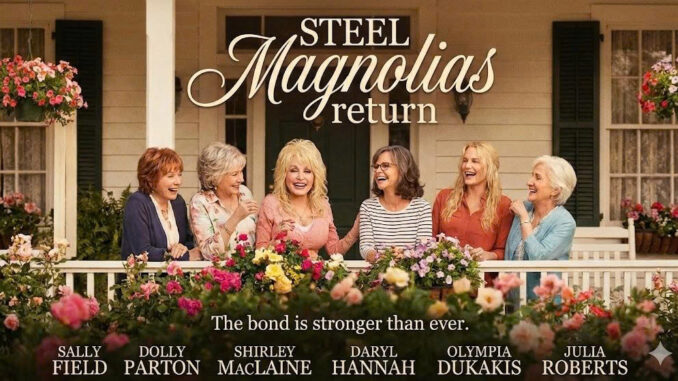
There is a moment in Steel Magnolias when everything changes—and yet, nothing visibly explodes.
No dramatic music announces it. No cinematic spectacle softens it. Instead, the film does something far more unsettling: it lets the pain arrive quietly, and then refuses to take it away.
For most of its runtime, Steel Magnolias carefully builds the illusion of resilience. The women laugh, argue, and support one another with a rhythm that feels almost unbreakable. Their bond appears strong enough to withstand anything. That is what the film wants you to believe.
And then it begins to dismantle that belief.
What makes the film so devastating is not the tragedy itself, but the way it exposes the limits of strength. These characters are not weak. They are not unprepared. And yet, when loss enters their lives, none of that strength is enough to stop it.
The emotional center of this unraveling lies in a performance that refuses restraint. Sally Field delivers a portrayal of grief that does not follow the rules of cinema. It is not graceful. It is not controlled. It is chaotic, contradictory, and painfully real.
Her character does not mourn in silence. She lashes out. She searches for someone to blame. She shifts between anger and despair in a way that feels almost uncomfortable to witness. In doing so, the film breaks away from the idea that grief should be dignified or composed.
This is where Steel Magnolias becomes something more than a story about loss. It becomes a study of emotional collapse.
The film suggests that strength, as it is often defined, is a performance. It is the ability to hold everything together in front of others. But what happens when that performance can no longer be sustained? What remains when composure fails?
The answer, according to Steel Magnolias, is not resolution. It is exposure. 
Every character is forced to confront a version of themselves they did not expect. The humor that once defined their relationships becomes sharper, more fragile. The support they offer each other is no longer lighthearted—it is necessary. Survival, in this context, is not about overcoming grief. It is about enduring it.
What makes this portrayal so powerful is its refusal to offer closure. The film does not rebuild what has been broken. It does not suggest that time will heal everything. Instead, it presents a more difficult truth: some losses are not meant to be resolved.
And yet, life continues.
This contradiction is what gives the film its lasting impact. It acknowledges that devastation and continuation can exist at the same time. That people can be both broken and functioning. That strength is not the absence of pain, but the decision to move forward despite it.
For many viewers, this is where Steel Magnolias becomes unforgettable. It does not manipulate emotion—it confronts it. It does not guide the audience toward comfort—it leaves them with recognition.
In the end, the film’s most powerful statement is also its simplest. Strength is not always visible. Sometimes, it looks like surviving a day that should have been impossible.
And that is what makes Steel Magnolias not just emotional—but enduring.