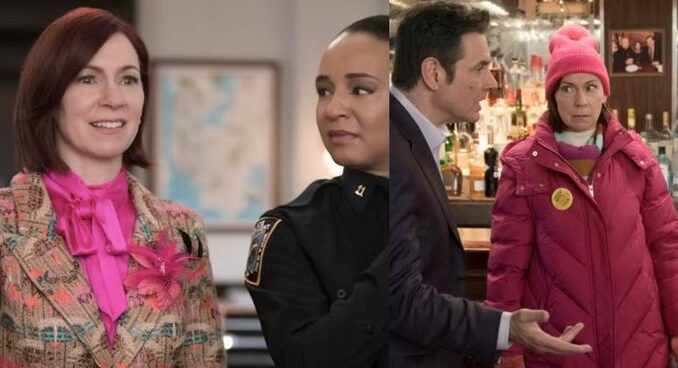
A Glitter-Filled Morning Turns Deadly
On what should have been a sparkling Sunday celebration of sequins, satire, and self-expression, chaos erupted at Manhattan’s trendiest drag brunch when a beloved wigmaker was found dead backstage. This week’s episode of Elsbeth delivers one of its boldest cases yet—an extravagant, razor-sharp mystery fans are already calling “The Shaving Head Case.”
Set against a kaleidoscope of glitter and glam, the story unspools inside the fictional Velvet Crown Lounge, where brunch mimosas meet high-camp performance art. But behind the rhinestones and punchlines lurks betrayal, obsession, and a deadly secret that cuts closer than anyone expected.
The Victim: A Legend in Lacefront
The victim, Silas Devereaux (a fictional character within the series), was no ordinary stylist. Known as the “Architect of Identity” in fashion circles, Silas crafted custom lacefront wigs for Broadway stars, drag royalty, and political fundraisers alike. His creations were rumored to cost more than a Manhattan studio apartment’s monthly rent.
Silas built an empire on transformation. Clients didn’t just leave his studio looking different—they left reborn.
Which makes the manner of his death particularly haunting.
Found in a backstage dressing room chair, a half-shaved wig clutched in his hand, Silas appeared to have been in the middle of preparing a dramatic reveal for the brunch’s headliner. Police initially suspected a tragic accident—perhaps a fall, perhaps a reaction to a chemical treatment. But Elsbeth Tascioni saw something others didn’t: the symbolism.
Why was the wig partially shaved?
And why did security footage mysteriously skip three crucial minutes?
Enter Elsbeth: Quirky, Calculated, and Always Listening
In Elsbeth, played brilliantly by Carrie Preston, the titular attorney-turned-investigator thrives on nuance. Where others see spectacle, she sees subtext.
This episode leans into everything that makes the show addictive:
-
Rapid-fire wit
-
Subtle social commentary
-
A murder weapon that’s more metaphor than metal
Elsbeth’s first instinct? “Nobody shaves a masterpiece halfway unless they’re interrupted—or making a statement.”
And that line lands like a clue in plain sight.
The Drag Brunch: Celebration or Crime Scene?
The Velvet Crown’s Sunday brunch is legendary. A rotating cast of drag performers lip-sync to pop anthems while servers glide between tables balancing champagne towers.
But that morning, tensions simmered beneath the sparkle.
The headliner, fictional drag icon Opaline St. James, was debuting a new persona—one that required shaving her signature platinum wig mid-performance as a statement about shedding expectations.
The wig? Designed by Silas.
Suddenly, the half-shaved prop backstage feels less like coincidence and more like motive.
Was the act of shaving meant to empower—or humiliate?
Motives in Mascara
The suspect list reads like a Broadway playbill:
-
Opaline St. James, the star performer whose career hinged on reinvention.
-
Marco Devereaux, Silas’s estranged nephew and business partner, drowning in debt.
-
Vanessa Cho, a rival wig designer recently edged out of a luxury contract.
-
The Club Owner, who had just insured the brunch event for an eye-watering sum.
Each had something to gain.
Elsbeth’s method isn’t about intimidation. It’s about patience. She listens to what people don’t say. She notices the stray glitter on a tailored sleeve. The faint scent of adhesive remover where it shouldn’t be.
And she asks questions that sound harmless—but land like cross-examinations.
The “Shaving Head” Symbolism
This episode cleverly reframes the concept of shaving one’s head—not as destruction, but as transformation.
Throughout history, head-shaving has symbolized:
-
Renewal
-
Protest
-
Punishment
-
Freedom
In this case, the act becomes layered with meaning.
Silas believed in transformation through illusion. But what happens when someone wants authenticity instead of artifice?
Elsbeth eventually uncovers that Silas had secretly altered Opaline’s performance wig without her knowledge—adding structural reinforcements that would prevent the dramatic onstage shave from working smoothly. Why? Because he believed the stunt would cheapen his craftsmanship.
Control. Ego. Ownership.
Sometimes the most dangerous motive isn’t money—it’s pride.
The Break in the Case
The turning point arrives not in a lab report—but in a laugh.
During questioning, Elsbeth notices Marco describing the shaving gimmick as “destructive.” Yet Opaline had publicly framed it as empowering. That subtle word choice exposes resentment: Marco saw transformation as loss.
Security footage, once “corrupted,” reveals Marco entering backstage with a solvent used to loosen wig foundations. The chemical reaction caused Silas to inhale toxic fumes in a confined space—leading to his death.
It wasn’t meant to kill.
But negligence, fueled by rage, can be just as lethal.
A Show That Dares to Be Bold
This week’s installment of Elsbeth proves why the series has found a devoted following. Unlike conventional procedurals, it doesn’t rely on grisly shock value. Instead, it explores identity, ownership, and reinvention through stylized storytelling.
The drag brunch setting isn’t used for spectacle alone. It becomes a backdrop for deeper themes:
-
Who owns an image?
-
Is transformation art—or autonomy?
-
When does collaboration become control?
The episode handles these questions with humor and humanity, avoiding caricature while celebrating the vibrancy of performance culture.
The Final Reveal
In classic Elsbeth fashion, the reveal happens not in a dark interrogation room—but during a recreated brunch performance.
As Opaline prepares to shave a replica wig onstage, Elsbeth interrupts—not to stop the show, but to explain the crime in front of a stunned crowd.
Marco’s plan had been simple: sabotage the performance, humiliate the star, force Silas to rethink his brand strategy.
He never anticipated that tampering with chemical adhesives in a poorly ventilated dressing room would trigger a fatal chain reaction.
The tragedy lies in ego unchecked.
The glamour fades.
And the curtain falls.
Why This Episode Works
This case stands out because it blends:
-
High camp aesthetics
-
Sharp legal insight
-
Emotional nuance
It avoids sensationalism while embracing theatricality. The shaved wig becomes a metaphor for stripping away illusion—revealing truth beneath.
For viewers, it’s a reminder that reinvention can be powerful—but control over someone else’s identity can be dangerous.