As we get ready to throw ourselves back into the lavish world of Bridgerton’s Ton and the scandalous commentary of a certain Lady Whistledown, one question lingers: was there a real-life version of the gossiping writer to skewer Regency high society?
The name Lady Whistledown is well known to fans of the hit Netflix series Bridgerton. It is the one chosen by the anonymous author of the scandal sheets that weave through the period drama, unfurling the latest whispers and intrigues of the Ton in the knowing tones of Julie Andrews.
Since the finale of the first season – beware, this is spoiler territory for those who have yet to watch it – we have known that the identity of Lady Whistledown is Penelope Featherington (played by Nicola Coughlan).
Often overlooked on London’s social scene, Penelope’s vantage point offers her a unique lens through which to dissect the life and loves of the season’s debutantes. It is this quick-witted commentary that captivates the masses, and even ensnares the attention of Queen Charlotte (Golda Rosheuvel), wife to the reigning king George III.
Were there actually scandal sheets in Regency Britain?
Queen Charlotte (Golda Rosheuvel) holding a copy of the latest Lady Whistledown instalment, in Bridgerton. (Picture by Liam Daniel/Netflix © 2022)
In short, yes. Scandalous revelations and insights were published in print, but mostly in the form of magazine or newspaper columns rather than standalone sheets.
Those hungry for such news turned to publications such as The Town and Country magazine, explains Hannah Greig, historical advisor on Bridgerton, on a new episode of the HistoryExtra podcast.
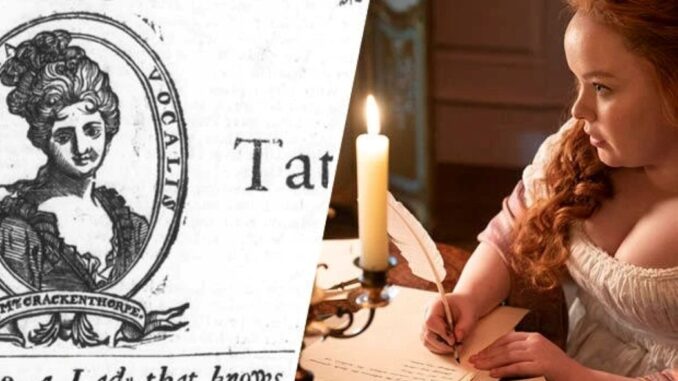
Mrs Crackenthorpe: the real Lady Whistledown?
Lady Whistledown might be entirely fictional, but the character may have had a real-life inspiration in the form of Mrs Crackenthorpe, who was writing in the early 18th century – around 100 years before the Regency era.
Like her Bridgerton-based counterpart, Crackenthorpe was a nom de plume created to conceal the author’s true identity – one that has never been confirmed. Instead, she uses the descriptor of “a Lady that knows every thing” (sic).
This all-knowing lady was behind the creation of The Female Tatler, a sheet that arose in 1709 and, despite being in circulation for just a year, managed over 100 editions. Published three times a week, specifically on the days its rival The Tatler wasn’t released, the first 51 editions were written by Mrs Crackenthorpe, before being taken over by “a society of ladies” for the next 58.