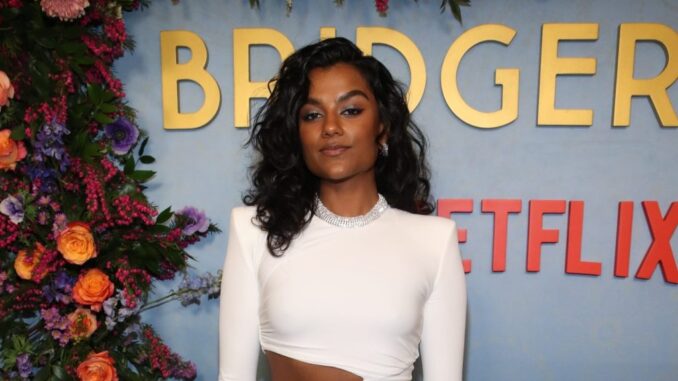
When Simone Ashley joined Bridgerton, the series gained its first South Asian romantic lead and one of its most grounded presences. On screen, Kate Bridgerton reshaped the show’s idea of desire and authority. Off-screen, Ashley has quietly taken on a different role. She has become a steady source of support for her castmates while navigating a production that often struggles with consistency on representation. As season four approaches, that contrast has become harder to ignore.
What the Media Has Reported
Recent coverage has repeatedly placed Simone Ashley at the centre of cast solidarity. She publicly defended Nicola Coughlan when online body shaming targeted her during season three press. She welcomed Masali Baduza after her casting as Michaela Stirling. She also reached out privately to Yerin Ha following the announcement that Ha would play Sophie Baek.
That backdrop sharpened reactions to comments from showrunner Jess Brownell, who said production worked with the Coalition of Asian Pacifics in Entertainment to ensure Sophie would not carry the burden of being the only Asian character on the show.
The phrasing immediately drew attention because Bridgerton had already centred two South Asian leads in season two through Kate and Edwina Sharma. For many viewers, the remark appeared to overlook that history, collapsing Asian identity into a narrower frame and treating earlier representation as complete rather than ongoing.
Even if the intention was to reference East Asian representation specifically, the lack of clarity mattered. Language that positions a new character as a first can unintentionally erase the visibility and impact of those who came before, particularly when those characters helped redefine the series at its peak.
How Fans Have Responded
Online responses cut across fandom lines. Many viewers questioned how a show that centred two Indian sisters in season two could describe a future lead as potentially the only Asian presence. Others argued Brownell likely meant East Asian and failed to say so. That explanation, however, sits against a backdrop of documented slights involving both Simone Ashley and Kate Bridgerton.

South Asian fans described the phrasing as familiar. Representation arrives, delivers success, then fades into the background. Kate and Edwina’s season changed the series for WOC, being seen as romantic leads in period dramas. Their legacy, however, often feels treated as complete rather than ongoing. The naming issue fed that feeling. So did the silence around Kate’s arc in later seasons.
Even with all that, Simone Ashley’s solidarity has continued to stand out. Fans praised her for reaching out before controversy took shape and for defending colleagues without being prompted. Fans framed her as someone who understood what visibility costs and how easily it narrows once the spotlight moves on. The sentiment kept returning to one idea. Ashley seemed more aware of the stakes than the institution surrounding her.
Why Simone Ashley’s Role Matters
She has shown cultural awareness in ways that went beyond her own performance. Simone Ashley has publicly confirmed that during season two, she suggested to the previous showrunner, Chris Van Dusen, that both actresses playing the Sharma sisters should be of full South Asian descent. In interviews, Ashley explained that the decision mattered to her because representation has a ripple effect, creating opportunities for people from different backgrounds rather than treating diversity as a one-off gesture. The change ensured the Sharma family reflected a shared cultural reality on screen, rather than a diluted or mismatched one.
At the same time, the show keeps tripping over its own language and continuity. Language that framed Sophie as carrying sole responsibility for Asian representation ignores the South Asian leads who already anchored the series.
Ashley has not made speeches or claimed the role of spokesperson. She has simply stepped in when it mattered. In an industry that often prizes appearances over follow-through, that approach is important. Her actions come from lived experience rather than a checklist.
As Bridgerton continues to grow, Simone Ashley has set a quiet example. Representation does not restart with each new season; it builds over time. The open question is whether the show will match the care its former lead has already shown.