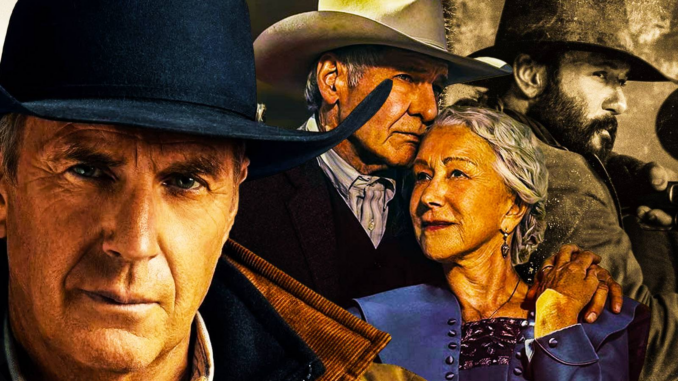
Yellowstone didn’t just become a hit TV show.
It became a storytelling universe.
With 1883 and 1923, the Dutton family saga expanded backward in time, turning a modern Western drama into a multigenerational epic about land, power, and survival.
And it’s far from over.
How Yellowstone Evolved From a Show Into a Universe
At first, Yellowstone looked like a standalone modern Western.
But beneath the surface, it carried something bigger:
-
Deep family history
-
Unresolved generational trauma
-
A mythic relationship with land
The spin-offs didn’t feel optional. They felt inevitable.
Why the Dutton Story Works Across Multiple Eras
The Duttons aren’t defined by time.
They’re defined by:
-
Obsession with land
-
Fear of losing control
-
Willingness to sacrifice morality for survival
These traits translate seamlessly across centuries.
That’s why the story stretches backward without losing relevance.
1883, 1923, and Yellowstone: Three Faces of the Same Conflict
Each series represents a different stage of power:
-
1883 – Survival without ownership
-
1923 – Ownership under threat
-
Yellowstone – Power under siege
Different eras. Same struggle.
The land never stops demanding blood.
Why Spin-Offs Strengthen Yellowstone Instead of Diluting It
Many franchises fail because spin-offs feel unnecessary.
Yellowstone spin-offs work because:
-
Each tells a complete story
-
Each explores a unique theme
-
None rely on cheap nostalgia
They deepen meaning rather than repeating formulas.
Thematic Consistency Across the Dutton Timeline
Despite different settings, the core themes remain consistent:
-
Legacy is a burden
-
Power corrupts slowly
-
Survival reshapes morality
This consistency makes the universe feel intentional—not fragmented.
Why Viewers Are Drawn to the Dutton Mythology
Audiences don’t just watch for drama.
They watch to understand:
-
Where power comes from
-
Why families self-destruct
-
How history justifies violence
The Duttons represent uncomfortable truths about ambition.
The Role of Trauma in the Yellowstone Universe
Trauma doesn’t disappear in this franchise.
It evolves.
Each generation inherits:
-
Fear
-
Anger
-
Entitlement
Spin-offs make it clear: modern dominance is built on past suffering.
Could Yellowstone Spin-Offs Move Forward in Time?
So far, the universe has expanded backward.
But moving forward is possible.
Future stories could explore:
-
The collapse of the Dutton ranch
-
A world where land no longer means power
-
The final cost of legacy
The groundwork already exists.
Why the Franchise Avoids Happy Endings
Yellowstone stories don’t reward characters with peace.
They reward endurance.
This refusal to provide clean resolutions keeps the universe grounded and mature.
The Risk of Oversaturation
Expansion always carries danger.
Too many spin-offs could:
-
Dilute emotional impact
-
Repeat themes
-
Exhaust audiences
So far, restraint has protected the franchise.
Quality has mattered more than quantity.
Why Yellowstone Spin-Offs Feel More Like Novels Than TV
Each series unfolds slowly.
Characters aren’t rushed.
Consequences linger.
Themes take time to settle.
This literary pacing separates Yellowstone from traditional TV franchises.
The Dutton Name as a Symbol, Not Just a Family
Over time, “Dutton” becomes more than a surname.
It becomes:
-
A warning
-
A brand
-
A symbol of ruthless preservation
Spin-offs explore how that symbol was forged.
How Spin-Offs Reframe Modern Yellowstone
After watching the spin-offs:
-
John Dutton feels less heroic
-
The ranch feels more cursed
-
Power feels more tragic
Context changes perception.
That’s the mark of strong world-building.
Why the Yellowstone Universe Resonates Globally
Although rooted in American history, the themes are universal:
-
Land ownership
-
Generational conflict
-
Moral compromise
Viewers around the world recognize these struggles.
What Makes Yellowstone’s Expansion Different From Other Franchises
This universe isn’t built on spectacle.
It’s built on:
-
Character
-
Consequence
-
Continuity
That depth gives it staying power.
Is the Yellowstone Universe Sustainable Long-Term?
Yes—if it remains disciplined.
As long as spin-offs:
-
Serve the story
-
Respect the timeline
-
Avoid nostalgia traps
The universe can continue to grow meaningfully.
Conclusion: Yellowstone Is No Longer Just a Show
The Yellowstone spin-off universe transformed a modern Western into a generational saga about how power is born—and what it destroys along the way.
Each spin-off adds weight, not noise.
And as long as the story keeps asking hard questions instead of chasing easy wins, the Dutton legacy will remain one of television’s most compelling worlds.
FAQs About Yellowstone Spin-Off Universe
1. Do I need to watch spin-offs to understand Yellowstone?
Not required, but they add deep emotional context.
2. Which spin-off is the most important?
Each serves a different purpose—none are redundant.
3. Will there be more Yellowstone spin-offs?
The structure allows for future expansion.
4. Are the spin-offs historically accurate?
They are fictional but grounded in real historical tension.
5. What is the core message of the Yellowstone universe?
Power survives—but never without cost.