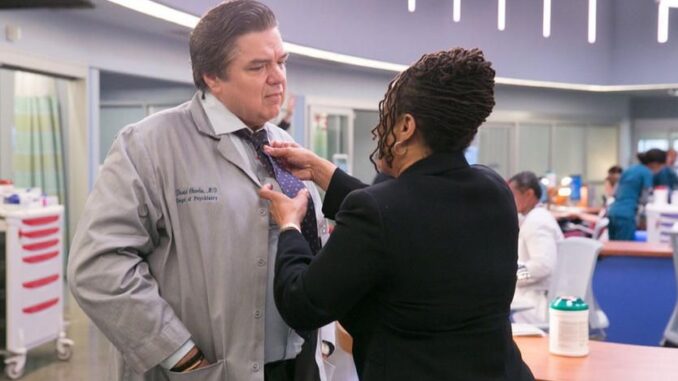
Chicago Med Season 11’s “The Book of Charles” and “Altered States” are great episodes, but there’s an important lesson to be learned from Dr. Daniel Charles—one I lived.
SPOILER ALERT AND WARNING: The following contains spoilers for Chicago Med Season 11, Episode 16, “The Book of Charles” and Season 11, Episode 17, “Altered States.” It also contains discussion of topics that may be sensitive for some readers, including mental health, death and suicide.
Chicago Med‘s “The Book of Charles” is the best episode of Season 11 for a variety of reasons. It and its successor “Altered States” are the most important episodes of the season—as it shines a light on part of the mental health conversation that isn’t had often enough. What happens to Dr. Daniel Charles is an honest, genuine depiction of the mental health stressors that caretakers—whether professionals like Dr. Charles or simply people who inhabit the caretaker role—live with, and how their sense of self can be affected.
This isn’t the first time that Chicago Med has provided perspective on an underrepresented medical issue. The character of Dr. Isidore Latham, and the friendship he built with Dr. Connor Rhodes, was a wonderful portrayal of neurological differences. Charles’ shared backstory with Dr. Mitch Ripley, as introduced in Season 9, prompted a discussion on how much mental health concerns in someone’s past can shape their future. Amongst the cases of the week, the NBC drama does have a knack for getting to the heart of certain matters. Any TV show helping more people to understand that mental health is health is a good thing, but between Ripley and now Charles, Chicago Med is at the forefront. Because while Dr. Charles’ fate is obviously important to One Chicago fans, hopefully this story arc also gets them to consider that even the most reliable, most outgoing and smartest people can face mental health challenges.
Charles’ mental health journey has been ongoing for years; he’s gone to both individual and family therapy, and during Season 7, actually dated his former therapist Dr. Lonnie Richardson after she confessed to developing romantic feelings for him. There was also the storyline of his daughter Robin’s mental health that played out in Season 2 and into Season 3. But for all of this, it’s not until “The Book of Charles” that audiences get valuable context on what Charles is driven by and what he’s searching for—and simply seeing him at what is unquestionably his lowest point is a statement on its own. Charles being shot in Season 3 was an external trauma that could be repaired; in Season 11, this is an internal collapse that affects his identity, and affects in a meaningful way how Chicago Med fans perceive the character.
It’s a storyline that will be a touchpoint for the character, and hopefully for the audience as well. I can attest to its importance because I have my own experience of standing somewhat where Dr. Charles is standing. I can speak only from my personal history, but I know the mental and physical health price that Charles ultimately ends up paying. And hopefully telling a little of my story will highlight why this story is worth telling.
As a psychiatrist, Dr. Charles is responsible for taking care of people who may not be able to help themselves. They might not fully grasp what’s happening with them or they may not even know something is wrong. There is an incredible amount of vulnerability in that—on both sides of the equation. As a patient, you’re entrusting things that are very personal and oftentimes very traumatic to someone in hopes that they’re going to be able to help you. But as the caretaker, you’re also opening yourself up to accept that emotion and that trauma on a regular basis. Just like the treatment dialogue goes both ways, so does the emotional weight. This is represented very well in “The Book of Charles” in the opening scene, when Charles is working at the suicide hotline. There are multiple reasons why that serves as the catalyst for the character’s unraveling, but one of them is knowing that he had the chance—the last chance—to save Gio and he wasn’t able to.
People who are caretakers inherently want to make a situation better. Whether it’s literally saving someone as a doctor or police officer, or working in the community, or saving a situation, there is a noble instinct to help. But with that comes a tendency (or sometimes even a job requirement) to put service over self. To subjugate one’s own emotional needs or even physical welfare because your energy or time is needed elsewhere. And as Chicago Med illustrates at the end of “The Book of Charles,” that can lead to serious consequences. The ending of the episode didn’t come as a surprise to me at all, because I’d already been there.
Like Dr. Charles, I’ve been a caretaker for most of my life, and like him that comes from a loss I experienced as a teenager. I’ve always been relatively selfless—owing to the fact that as a young woman with a disability, I was marginalized and written off and outright bullied on a regular basis, often by people in positions of authority. It’s very easy to prioritize other people over yourself when you’re made to feel that you have no value. But I doubled down on that in my senior year of high school, when my best friend was killed in a car accident. The accident was completely avoidable, and I carried survivor’s guilt over that for years, because he died on the one day that I wasn’t with him. I believed that had I been there, I could have saved his life. Unfortunately, I didn’t have a Dr. Charles to tell me otherwise. I carried that guilt and the negative impact it had on my self-image for years of my life. I was eventually diagnosed with Post-Traumatic Stress Disorder, and I committed myself to making a positive difference in the world as a way of honoring his memory.
But another thing “The Book of Charles” gets right is that being selfless isn’t just the sacrifices of time or effort. It’s that caretakers often don’t talk about or recognize the importance of when we need help or we’re in pain. It’s a bad habit to keep quiet or brush things off, and so people believe you’re fine. They also tend to take you for granted. After all, you’re always going to be there when they need you. Think about how we see Dr. Charles in the world of Chicago Med: most times, another doctor calls him for a consult and he shows up in the ED. After the exit of Dr. Sarah Reese in Season 4, viewers haven’t seen much of the psychiatry department as a whole. We know there are other people who work there, and we get a fair amount of scenes with Charles in his office, but for the most part Charles’ professional world exists off-screen. When viewers see him, he’s just the guy who comes to the rescue. (This can also be said of Sharon Goodwin to a different degree, but more on that later.)
I previously found myself in a position where I was working 20 to 22-hour shifts, six or often seven days a week, over an 18-month span. I was not only overseeing an entire team but also providing a large portion of that team’s output. I prioritized their needs over my own well-being, to the point where I had days where I’d survive on one meal and two or three hours of sleep. I was suffering physically and emotionally but kept pushing through it for the greater good. It did not come as a surprise to me when I collapsed just like Dr. Charles—except rather than a stroke, I was having a complete mental and physical breakdown. I spent months in recovery, both healing physically and letting go of things mentally. I probably won’t ever be the same person, but I’m a happier and healthier person now that I’m putting myself first instead of everyone else. However, I’d be lying if I told you that I don’t still want to help everyone. Writing this editorial is an example of that, hoping that sharing my experience helps to add something to what I feel is an important message.
The biggest thing Chicago Med fans can take from “The Book of Charles” and “Altered States” is that those who are caretakers still need someone to take care of them. That when people are always there for everyone else, they don’t have as much time or resources or emotional space for themselves, and that discrepancy may not be obvious. It may take years or in this case 11 seasons for the cracks to show, but the people who seem the most together may be carrying the most weight. And they will break. And that’s why this tale could only be told through Dr. Daniel Charles and Oliver Platt, and why it works so well now.
THE MEANING OF DR. CHARLES
As meaningful as this storyline is, it doesn’t work with any other character other than Dr. Charles. It might work to a lesser extent with Goodwin, but it makes the most sense and it only fully resonates with Charles. That has to do not only with Charles’ role within Chicago Med, but what Oliver Platt is able to bring to the audience as well. “The Book of Charles” is trading on 11 seasons of history and on Platt’s inherent credibility with viewers, and those things are why it can make its point.
Dr. Charles is one of only two characters who has been part of Chicago Med for its entire run. He and Goodwin are the foundation of the show. That tenure provides certain narrative advantages; the audience is incredibly invested in them, and feels like they know them well. Viewers have spent over a decade welcoming Dr. Charles into their home almost every week. Other characters have come and gone, but he’s always there as much for the fans as he is for the doctors who ask for those consults. He’s a fan-favorite because he’s everybody’s safe place.
And while he’s gone through his fair share of challenges in that time—he just lost one of his oldest friends earlier in Season 11, and his mother died near the end of Season 10, to name but two—he always rebounds. He has the demeanor to put everyone at ease, and it takes a lot to push him into showing anything other than patience and calm. The man has a bedside manner people should aspire to. So that creates this belief that Charles is okay and will always be okay. He handles most things so well, and even if something goes really wrong, he’s going to be able to get through it.

“The Book of Charles” pulls the rug out from under the audience in that way, and reminds the fans that even after all this time, Charles can still not be okay. And then one starts to ask questions: how long has he really not been okay? What have we missed? What has he missed? Wait, it’s possible for him to miss something?
Those same questions can’t be asked with any other character on Chicago Med. All the other characters on the show are great, but nobody outside of Goodwin has the tenure and cache with the audience that Charles does. In fact, it could be argued Charles has more because he’s a more direct participant in cases every week, whereas Goodwin often moves in and out of episodes. Having this happen to somebody who’s only been on the show a few seasons, no matter how interesting the character, wouldn’t have the same impact because it’s not 11 years in the making. And because those other characters aren’t the psychiatrist, whom everyone assumes must know what’s going on in their own head since they’re the expert.
Those characters also aren’t played by Oliver Platt. A large part of the success of Dr. Charles is owed to the actor portraying him. Aside from being enormously talented, he’s already a familiar face; he’s had so many other roles that people have loved, from Oliver Babish in The West Wing to Paul Jamison in The Big C, and if you haven’t seen him as Russell Tupper in Huff you’ve missed out. Even when he’s playing more polarizing characters—see his portrayal of George Steinbrenner in The Bronx is Burning—people gravitate toward him because it’s Oliver Platt. He’s someone whom it is easy for the audience to embrace.
It’s not just his acting ability, but his inherent warmth that’s made him a perfect fit for Dr. Charles. He’s somebody whom the viewer would want to open up to. There have been other TV doctors in the same field, but Charles has stood out because Platt is so natural in the role. There’s no pretentiousness in his performance and the fans never doubt his sincerity—which is the biggest red flag in “The Book of Charles,” when Sage calls him out so clearly and so emphatically. It’s genuinely shocking to think anyone would think of Dr. Charles that way. We perceive him as a favorite uncle, a mentor, even a hero. So when we see him as deeply human, it’s a wake-up call, not only in how we see him but how we might see ourselves.
This storyline isn’t all doom and gloom, however. “The Book of Charles” and “Altered States” bring renewed attention to the friendship between Charles and Goodwin, and how we should all hopefully have a friendship like that.
CHARLES’ STORY IS ALSO GOODWIN’S STORY
As Chicago Med showrunner Allen MacDonald told us, it’s absolutely intentional that the last major interaction Charles has before his stroke is his fight with Goodwin. That scene is the most painful to watch not because it’s the biggest argument, but because that friendship means so much. To set it on fire is something that isn’t going to be forgotten. It’ll be forgiven and moved past, but it leaves a mark. Again, that’s a shared reaction between both the characters and the audience, pulling the viewers deeper into the spiral that Charles is in. Everything that happens in “The Book of Charles” is what’s happening to Charles, like the audience is watching this impending car crash that they’re powerless to stop. By “Atered States,” the audience is Dr. Charles.
MacDonald does a really neat thing in having the two key scenes between Charles and Goodwin, as diametrically opposed as they are, happen near the beginning and end of “The Book of Charles.” They’re the poles of the episode, as the characters go from planning for drinks to Charles tearing down his closest friend. MacDonald uses the friendship between Goodwin and Charles as a barometer for fans to realize how serious things are, but also in “Altered States,” to see how they’re getting better. Because even though the duo don’t speak to each other until the end of “Altered States,” the conversation Goodwin has with Anna Charles reinforces exactly how much Daniel not only loves but trusts Goodwin. There’s no greater choice that someone can make than to put their life literally in that person’s hands.
Goodwin has to be a part of Charles’ story not only because of canon, but because both characters have similar places in the Chicago Med world. It’s also expected that Goodwin is always going to be there; it’s mind-blowing to realize S. Epatha Merkerson has spent most of three decades working on Dick Wolf shows. And Goodwin, like Charles, always holds everything together so all the other characters can go and have their hero moments. It would be incredibly interesting to bookend “The Book of Charles” with “The Book of Goodwin,” and explore how this experience with Charles might prompt Goodwin to reflect further on her own emotional health.
But in the most intense way, “The Book of Charles” and “Altered States” highlight Goodwin’s importance in Charles’ life. She is the ally that he needs to take care of him while he’s taking care of everyone else, and he’s done the same for her before; they fill that role to keep each other balanced. When Charles breaks that balance by pushing her away, fans see how it throws both of them off-kilter. Chicago Med fans can also take away how important it is to be a Goodwin for the Charles in their lives. Because having that ally can make all the difference—both in terms of having that support and in how the caretaker sees themselves.
In the weeks and months after my breakdown, I was in and out of both hospital appointments and therapy appointments. But the harshest reality was that I heard almost nothing from the people I’d spent all that time trying to help. I made several attempts to reach out for help both before and after my breakdown, and I was stunned at how little of a response I got. I thought I had plenty of friends, and instead I was pleading not to be left alone, only to be left alone.
I had sacrificed my mental and physical health only to be treated as expendable, and that dealt a huge blow to my self-image. I once again felt worthless on top of being exhausted, and I contemplated suicide at one point before I reconnected with someone who actually saw me. I learned (and am still learning) that I can focus on myself, and that while there may not be many people who care about me, my corner isn’t empty. That being a caretaker doesn’t mean that you can’t be taken care of, too. No one—no matter how smart or talented or compassionate—can stand alone. Nor should they have to. That last scene of Goodwin and Charles together is the hope for Charles, that Charles has always given to everyone else.
That ultimately is what makes “The Book of Charles” and “Altered States” beautiful. Allen MacDonald and Deanna Shumaker don’t tell this story without a way out. They’re not simply tormenting their two most beloved characters for dramatic value, although he has plenty of that. They’re telling an important story about who Dr. Daniel Charles is, but also telling the story of this meaningful friendship, and showing how everyone is going to grow through this experience. It’s strenuous and it’s terrifying, but it’s important and there’s something positive that will come out of ot it on the other side. And that message perfectly fits this character. It’s something that Dr. Charles would be proud of.
Chicago Med airs Wednesdays at 8:00 p.m. ET/PT on NBC.