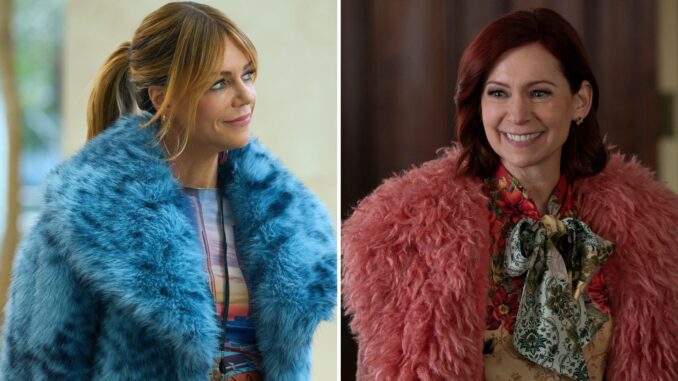
The plight of being a woman. You can be absolutely brilliant, and yet sometimes the most lively discussion revolves around your wardrobe.
It’s something that comes to mind when our passionate Facebook followers flock to nearly every article we post about High Potential and Elsbeth, with a chorus of thoughts about how they dress.
“Unprofessional,” some say. “Ridiculous,” others reply. “Why can’t she dress like a cop?” Others say. And to that, I circle back around to one key sentiment: the fashion is the point!
When you dive into your favorite shows, there are so many elements at play that make it this piece that you love. Often, we think about acting and writing; those are the two largest factors that people fixate on.
Others can appreciate the direction, the cinematography, and even a great score. But do you know what else is integral to bringing a character to life? Fashion.
When I see how frequently people dissect Morgan Gillory’s fashion choices and taste on High Potential, it’s often amusing to me because she’s such a distinct character.
She also happily plays into a common enough trope: The Bunny Ears Lawyer, or the Quirky but Competent sort.
Essentially, one looks at someone like Morgan and instantly writes her off based on her attire, when in reality, she’s brilliant and almost always the smartest person in the room.
Think Elle from Legally Blonde meets Erin Brokovich.
But there’s so much more to that, too. Morgan isn’t a Ditzy Genius, but she is a working-class mom with a particular fashion sense that also serves as a reminder of her status in life, and, again, that’s the point.
When you really take the time to understand Morgan in relation to her fashion sense, there’s a reason why it’s so distinctive and integral to who she is as a character.
It’s meant to tell us so much about her at first sight, before she even opens her mouth.
When I see Morgan Gillory, I see a modern version of The Nanny‘s Fran Fine.
She was infamously perceived as a fashionista, but only in certain circles.
Her aesthetic, especially in relation to her standing among the Sheffields, was crucial to distinguishing or rather defining her as a character.
In Queens, among Blue-Collar circles, she was likely a hot commodity. In contrast, compared to the higher-class echelon of the Sheffields world, her fashion was regarded as brash, gaudy, tacky, and tasteless.
Yet Fran Fine is a fashion icon, memorable, with a style some relate to, even if it’s not to everyone’s taste, because it’s real.
Fran’s fashion served as an integral part of her identity. She wore her socioeconomic class proudly and unapologetically. And that’s what we see from Morgan as well.
Morgan’s fashion tells us a lot about this woman who grew up on the wrong side of the tracks.
Finding bargain-bin statement pieces speaks to a woman with her own sense of style who doesn’t let her lack of money or social standing stop her from expressing herself.
In a police station, sure, to an outsider, there may not be much of a distinction between this squad’s highly intelligent consultant and a streetwalker in the cell. Yes, many have compared our girl to a Lady of the Night.
But, again, that’s the point, isn’t it? Fashion informs. Morgan’s fashion sense is a direct reflection of her class, which, in turn, can develop its own subculture.
I don’t know where you live, but where I do, you can almost pinpoint which town or neighborhood someone comes from just by their clothes.
Anyone who has ever tuned into Claws understands this as well. Or Married with Children — non-conformist style isn’t anything new.
Animal prints, heels, nails, jewelry — when you don’t have the funds, you flaunt and express yourself in other ways. It’s a not-so-subtle “eff you,” and it’s also just… fun.
That these fashion choices are so bold speaks to an attitude that can be universal amongst the working class. You know, those used to be ignored and looked down upon.
It’s garish because they will be seen and heard when society, particularly the upper-crest, would rather not see them at all.

Sometimes, demanding that someone conform and comply sounds a lot like asking them to apologize — erase the things about themselves that others deem shameful.
High Potential only functions as well as it does because everyone underestimates Morgan at first glance. They write her off as “trashy,” “ignorant,” or “classless.”
Those descriptors certainly have a distinctive ring to them, don’t they? Especially on who we apply them to and why.
The intersectional ways society perceives gender, class, and intellect manifest in this brilliant, beautiful, feminine, carefully curated, and intentional fashionista.
So, no, Morgan Gillory doesn’t need to “dress more professionally.” To do so would undermine everything that she is and represents. Morgan changing her aesthetic misses the point.
Similarly, Elsbeth Tascioni is another leading lady whose fashion choices often get people talking.
For Elsbeth, she’s also the Bunny-Ears Lawyer trope with a dash of Genius Ditz, too.
While Morgan’s fashion sparks discussion about sexuality and class, Elsbeth’s fashion revolves almost exclusively around whether she’s a smart person or an eccentric airhead.
In many ways, she’s in a similar field as Criminal Minds‘ Penelope Garcia and NCIS’ Abby Sciuto.
Wardrobe is more a reflection of personality than anything else, but it also invites snap judgments that are proven wrong when these ladies get to shine.
For Elsbeth, her bright colors, unusual textures and patterns, and statement hats and big bags aren’t some indication of her status in life or a reflection of her roots. They’re a reflection of her quirky personality and what she’s drawn to.
But they also serve to mask her superpower.
On the surface, people write her off as ditzy. Her exuberance operates as a shield, her bright colors a distraction, and what reads as ADHD often leads to people assuming she’s childlike, naive, or just stupid.
It’s that unassuming quality, her ability to distract and deflect with bright colors, feathers, and fur, that makes her such a force.
She’s brilliant, astute, and incredibly observant, but often people let their guard down around her precisely because her aesthetic isn’t something they take seriously. So she isn’t someone whom they take seriously.
Elsbeth’s fashion is as much a form of expression as it is a strategic move. While Morgan Gillory’s aesthetic is a form of defiance, Elsbeth’s serves as a weapon.
She gets the bit, plays into it. Her wardrobe is festive and fun, but it’s intentionally ostentatious.
That’s why it’s always puzzling when there’s criticism about Elsbeth’s ensembles or, worse yet, a call for her to “tone it down.”
A muted version of Elsbeth doesn’t just strip her of her identity. It also removes the most powerful tool in her belt.
Elsbeth thrives on her ability to turn people’s and society’s perceptions of her against them. Why would you want to deprive the character of one of her most prominent strengths?
Because you find her tacky? Kooky? Unprofessional? Because she doesn’t conform to our standards for what we deem acceptable in work environments?
That’s the point.
Fashion is a wonderful vehicle for telling stories and building characterization.
So, I’ll happily take my protagonists with stiletto boots, animal prints, and furry bucket hats.
To the Divas, Debonair, and everyone in between, I’m turning it over to you. Do you appreciate how fashion informs characters like Elsbeth and Morgan, or would you prefer they conform more?