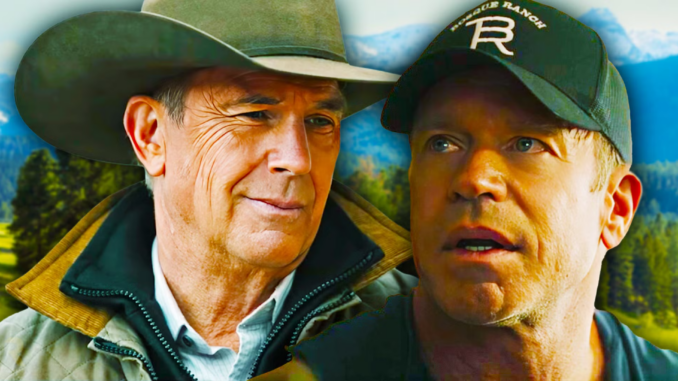
The rolling hills of Montana have become more than just a backdrop for a television show; they have transformed into a modern-day battlefield where the ghosts of the Old West collide with the relentless march of the twenty-first century. At the heart of this conflict stands John Dutton, the patriarch of the Yellowstone Ranch, a man whose identity is so deeply intertwined with the land that the two are virtually indistinguishable. As the series approaches its long-awaited conclusion, a singular, haunting question hangs over the Big Sky Country: Is this truly the end of the Yellowstone legacy?
The narrative of Yellowstone has always been a Shakespearean tragedy dressed in denim and Stetson hats. Since its inception, Taylor Sheridan’s neo-western has captivated millions by exploring the brutal lengths a family will go to protect their heritage. John Dutton, portrayed with a weathered gravitas by Kevin Costner, represents a dying breed of American icons. He is a man who values soil over gold and tradition over progress. However, the very walls he built to protect his empire have increasingly become its cage. The internal rot of the Dutton family, fueled by the sibling rivalry between the calculating Beth and the estranged Jamie, has proven to be a more formidable threat than any land developer or corporate raider.
As we look toward the final chapters, the stakes have never been higher. The political landscape has shifted, with John stepping into the role of Governor—not out of ambition, but out of a desperate need to use the law as a shield for his private interests. This move highlighted the central irony of his character: to save the ranch from the modern world, he had to become a central figure in the very systems he despises. This “final stand” is not just about physical land; it is a battle for the soul of the West. If the Duttons lose, the ranch will likely be carved into vacation homes and ski resorts, erasing a century of history in the name of profit.
The uncertainty surrounding the production itself has only added to the sense of an ending. Behind-the-scenes drama and the departure of key figures have mirrored the onscreen chaos, leading fans to wonder if the legacy can survive without its center of gravity. While the Yellowstone universe has expanded through prequels like 1883 and 1923, the flagship series remains the emotional anchor. Without John Dutton to hold the line, the “legacy” becomes a fragmented thing—a collection of memories rather than a living, breathing entity.
One must consider what a “legacy” actually means in the context of the Dutton family. Is it the preservation of the land, or is it the continuation of the bloodline? The tragedy of John Dutton is that in his quest to save the ranch for his children, he may have destroyed his children in the process. Kayce is torn between his father’s world and his own family, Beth is consumed by a vengeful loyalty that leaves little room for peace, and Jamie has become the ultimate antagonist, a product of the family’s own making. If the ranch survives but the family is broken beyond repair, has the legacy truly been preserved?
The final stand of John Dutton is likely to be a pyrrhic victory at best. The series has never shied away from the idea that the “cowboy way” is a fading light. The world is getting smaller, more regulated, and less tolerant of the frontier justice the Duttons dispense from the back of a horse. Whether the end comes through a legal gavel, a developer’s checkbook, or a final, violent confrontation, the sense of finality is palpable.
Ultimately, Yellowstone has succeeded because it taps into a universal anxiety about the loss of place and the passage of time. We watch John Dutton fight because, on some level, we all want to believe that something can be permanent in an ever-changing world. But as the sun sets over the Montana horizon, it becomes clear that legacies are not just built on dirt and barbed wire; they are built on the choices we make and the people we leave behind. Whether the Yellowstone ranch stands or falls, the story of the Duttons will remain a definitive portrait of the American spirit—beautiful, violent, and ultimately, mortal. The end may be near, but the shadow cast by the Yellowstone legacy will stretch far across the plains for years to come.