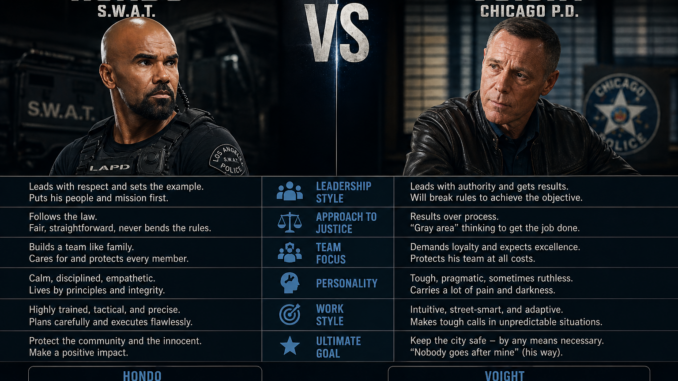
Hondo (S.W.A.T) and Voight (Chicago P.D): Who Is the True Enforcer of Justice?
Justice isn’t a straight road. It twists, doubles back, and sometimes disappears into fog. That’s where Daniel Harrelson and Hank Voight live—right in the thick of that uncertainty.
They wear the same badge, but it doesn’t mean the same thing in their hands.
Two Cities, Two Different Temperatures
In S.W.A.T., Los Angeles feels like a stage under bright lights. Every move Hondo makes is seen, judged, and remembered. He leads knowing that one wrong call doesn’t just affect a case—it can fracture trust across an entire community.
In Chicago P.D., the tone shifts. Chicago feels like a city that doesn’t wait. Problems don’t politely line up—they crash through the door. And Voight? He meets that chaos head-on, no hesitation, no second guessing.
Hondo: Justice With Structure
Played by Shemar Moore, Hondo is the kind of leader who treats the law like a spine—it holds everything upright.
He doesn’t rush decisions. He builds them.
You can see it in how he leads his team. There’s trust there, not fear. His authority doesn’t come from intimidation, but from consistency. People follow him because they know where he stands, even in a storm.
But here’s the trade-off. That careful approach can feel slow in a world that demands speed.
Voight: Justice Without Boundaries
Portrayed by Jason Beghe, Voight operates like a pressure valve ready to burst.
Rules? Useful… until they’re not.
He believes justice isn’t about process—it’s about outcome. If bending the law saves lives, he’ll bend it. If breaking it ends a threat, he won’t hesitate.
That unpredictability makes him dangerous, not just to criminals, but to the idea of justice itself.
And yet, you can’t ignore one thing—he gets results.
Leadership: Calm Anchor vs Moving Storm
Hondo leads like an anchor. Steady. Grounded. His team knows he won’t drift, no matter how rough the water gets.
Voight leads like a storm. Fast, forceful, and impossible to ignore. His team follows because standing still isn’t an option when he’s in motion.
One builds stability. The other creates momentum.
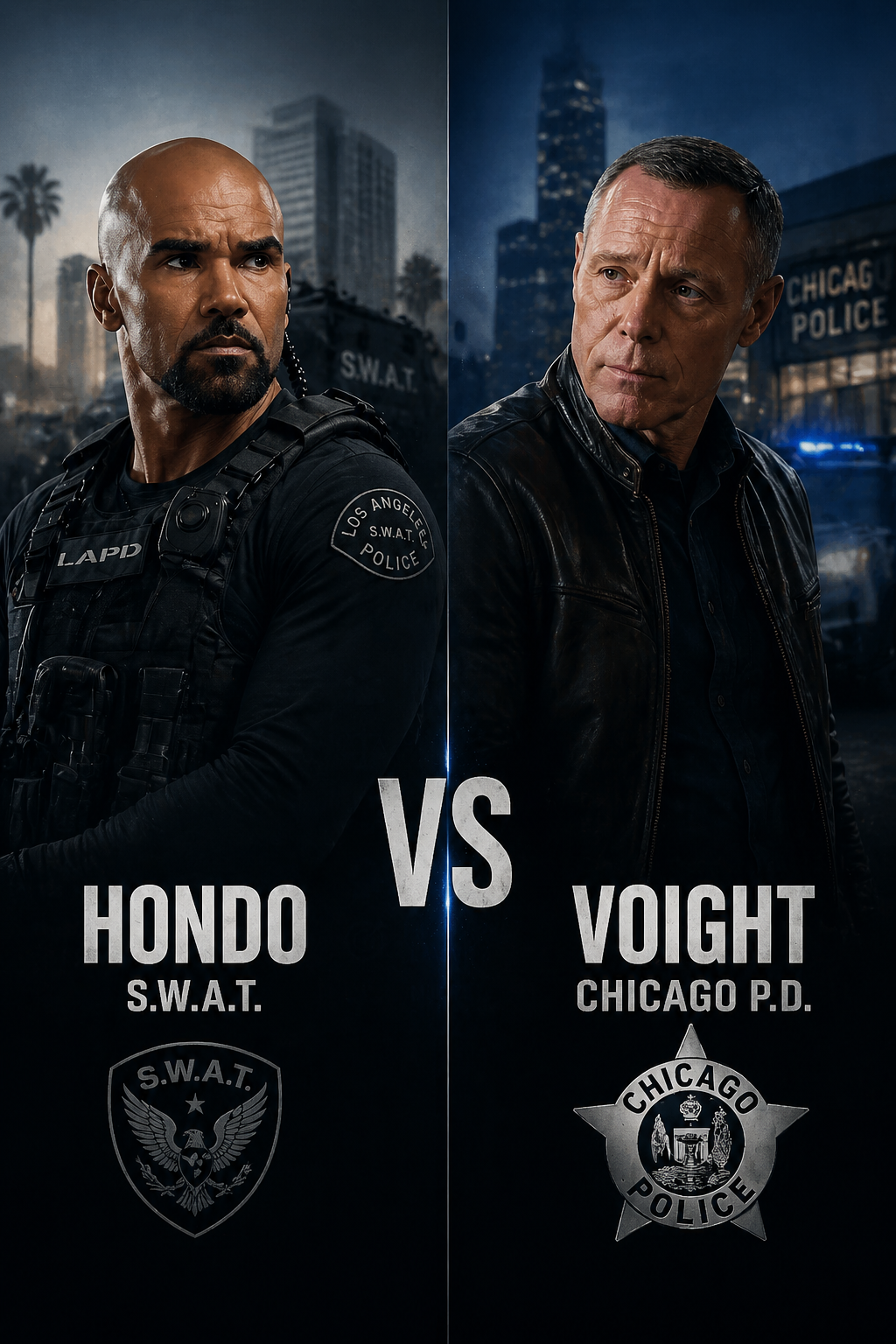
Morality: Clear Lines vs Blurred Edges
Hondo sees morality as a line you don’t cross. Once you step over it, coming back isn’t easy.
Voight sees morality as flexible. A tool. Something that adapts depending on the situation.
It raises a question that sits quietly but hits hard: if breaking the rules saves lives, is it still wrong?
Hondo would say yes.
Voight would ask how many lives were saved.
Results vs Principles: The Core Conflict
This is where everything collides.
Hondo focuses on doing things right. His victories last longer because they’re built on trust and accountability.
Voight focuses on finishing the job. His victories are immediate, decisive, and often final.
It’s like planting a tree versus cutting one down. One takes time but grows. The other is instant but leaves a mark.
The Emotional Difference
Hondo carries his emotions like a steady current. They guide him, but they don’t control him.
Voight locks his emotions away. But when they slip out, they hit hard and fast, like a crack of thunder you didn’t see coming.
That emotional gap shapes every decision they make.
Who Is the True Enforcer of Justice?
There’s no clean winner here.
If justice means fairness, trust, and long-term impact, Hondo stands taller.
If justice means immediate action, fearlessness, and results at any cost, Voight takes the lead.
The real answer depends on what kind of world you believe in.
One where rules protect justice.
Or one where justice survives by breaking them.
Conclusion
Hondo and Voight aren’t opposites—they’re reflections in different mirrors.
One shows what justice should aspire to be.
The other shows what it becomes under pressure.
And maybe that’s why this debate never fades. Because deep down, we know the truth isn’t simple.
Sometimes justice needs patience.
Sometimes it demands force.
And sometimes… it walks a line between both.
FAQs
1. Who is more realistic, Hondo or Voight?
Both reflect reality in different ways. Hondo represents ideal policing, while Voight explores the darker, more controversial side.
2. Why do fans like Voight despite his methods?
Because he delivers results and operates in morally complex situations that feel intense and unpredictable.
3. Is Hondo too idealistic?
Some might think so, but his approach builds long-term trust, which is crucial in real-world policing.
4. Could Hondo and Voight work together?
They could, but it would be tense. Hondo would try to enforce boundaries, while Voight would constantly push them.
5. Which character is a better leader overall?
It depends on the situation. Hondo excels in stability and trust, while Voight thrives in high-risk, high-pressure scenarios.