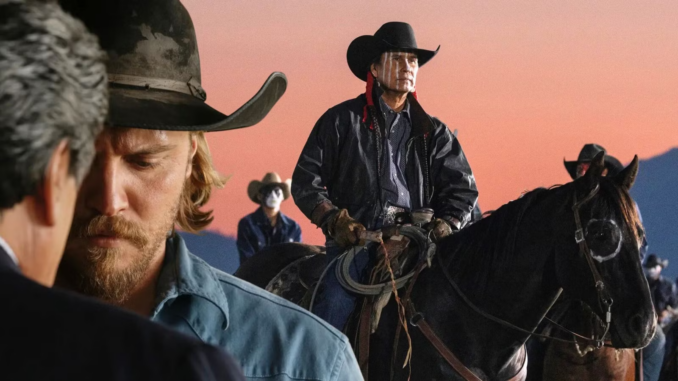
The long-awaited conclusion to the modern American epic has finally arrived, and the dust settling over the Montana wilderness has revealed a landscape forever changed by the blood and ambition of the Dutton family. For years, Taylor Sheridan’s masterpiece has kept viewers on the edge of their seats with its blend of neo-western grit and Shakespearean tragedy. Now, with the credits rolling on the final chapter, the question of who dies, who survives, and what the future holds for the largest contiguous ranch in the United States has been answered in a sequence of events that was as brutal as it was poetic. The finale did not just provide closure; it served as a final testament to the heavy price of protecting a legacy in a world that has no room for kings.
The central mystery that has haunted the final season was the fate of the patriarch himself, John Dutton. In a move that stayed true to the show’s unforgiving nature, the finale confirmed that the era of John Dutton has come to a definitive end. While the circumstances surrounding his departure were steeped in political intrigue and the fallout of his war with Jamie, his death served as the ultimate catalyst for the ranch’s final transformation. It was a somber, grounded moment that reflected the reality of the West: even the most powerful men are eventually reclaimed by the land they tried to own. His death left a vacuum that immediatey ignited a firestorm between his surviving children, proving that without the father, the siblings were destined to consume one another.
In the fallout of the power vacuum, the body count continued to rise. The most tragic and perhaps inevitable death was that of Jamie Dutton. After seasons of betrayal and internal conflict, Jamie’s journey reached its end in a final, lethal confrontation with Beth. Their lifelong feud, built on decades of secrets and mutual hatred, could only end in a scorched-earth scenario. Jamie, the man who tried to use the law to kill his father’s dream, was ultimately taken down by the very family ferocity he tried to escape. His demise marked the end of the legal threat to the ranch but at a cost that Beth will likely carry for the rest of her life.
Amidst the carnage, several key figures managed to survive, though they emerged as shells of their former selves. Beth Dutton remains the standing queen of the wreckage, having successfully defended the memory of her father at the expense of her own peace. Alongside her, Rip Wheeler stands as the eternal guardian of the Yellowstone brand. Their survival ensures that the Dutton name continues, but the victory feels hollow. They have kept the land, but they have lost the family that made the land worth having. Meanwhile, Kayce and Monica represent the only flicker of hope for a peaceful future. By choosing to distance themselves from the violence of the main house, they survived the final reckoning, signaling a transition from the old ways of the ranch to a more sustainable, less violent existence.
As for what comes next, the finale laid the groundwork for a massive shift in the Yellowstone universe. With the main branch of the story concluded, the focus now turns to the evolution of the land itself. The ranch is no longer a sovereign kingdom; it is a monument to a fading way of life. The survival of characters like Walker and the other bunkhouse regulars suggests that the spirit of the cowboy will endure, even if the empire that housed them has crumbled. The legacy of the ranch is now in the hands of the next generation, specifically Tate Dutton, who carries the blood of both the settlers and the indigenous people who originally called the valley home.
The finale also teased the expanding horizons of the franchise. While the story of John Dutton is over, the foundations laid in Montana connect directly to the upcoming spin-offs and sequels. The struggle for the American West is far from over; it is merely changing shape. Corporate interests may have been staved off for now, but the pressure of the modern world remains a constant threat. The resolution of the main series serves as a bridge to a new era where the battles will be fought in boardrooms as much as on horseback.
Ultimately, the Yellowstone finale was an emotional powerhouse that stayed true to its roots. It didn’t offer easy happy endings or clean resolutions. Instead, it provided a realistic, often painful look at the consequences of loyalty and the tragedy of obsession. Those who died did so because they couldn’t let go of the past, and those who survived did so by acknowledging that the future cannot be stopped. As the screen faded to black, viewers were left with the image of a vast, beautiful wilderness that remains long after the people who fought over it are gone. The saga of the Duttons is a reminder that while empires fall, the land remains, silent and indifferent to the dramas of men.